


Alice Cooper (June 7 1973) Horror? – Two‑Page Report Bravo Magazine
Publication: Bravo Magazine Date: June 7 1973
Country: Germany Section / Page: Two‑Page Feature
Format: Report / Opinion Column / Stage‑Act Analysis
Overview
A vivid Bravo report examining Alice Cooper’s infamous “game with death” during the Billion Dollar Babies tour. The article blends eyewitness description, moral debate, and youth‑press commentary, framing Cooper’s guillotine routine as both thrilling theatre and a cultural flashpoint. Bravo positions the act not merely as shock entertainment but as a generational statement — a challenge to adult norms and a reflection of early‑’70s youth identity.

What the Clipping Shows
•Two‑page spread titled “Horror?” with bold sub‑headings and dense German text.
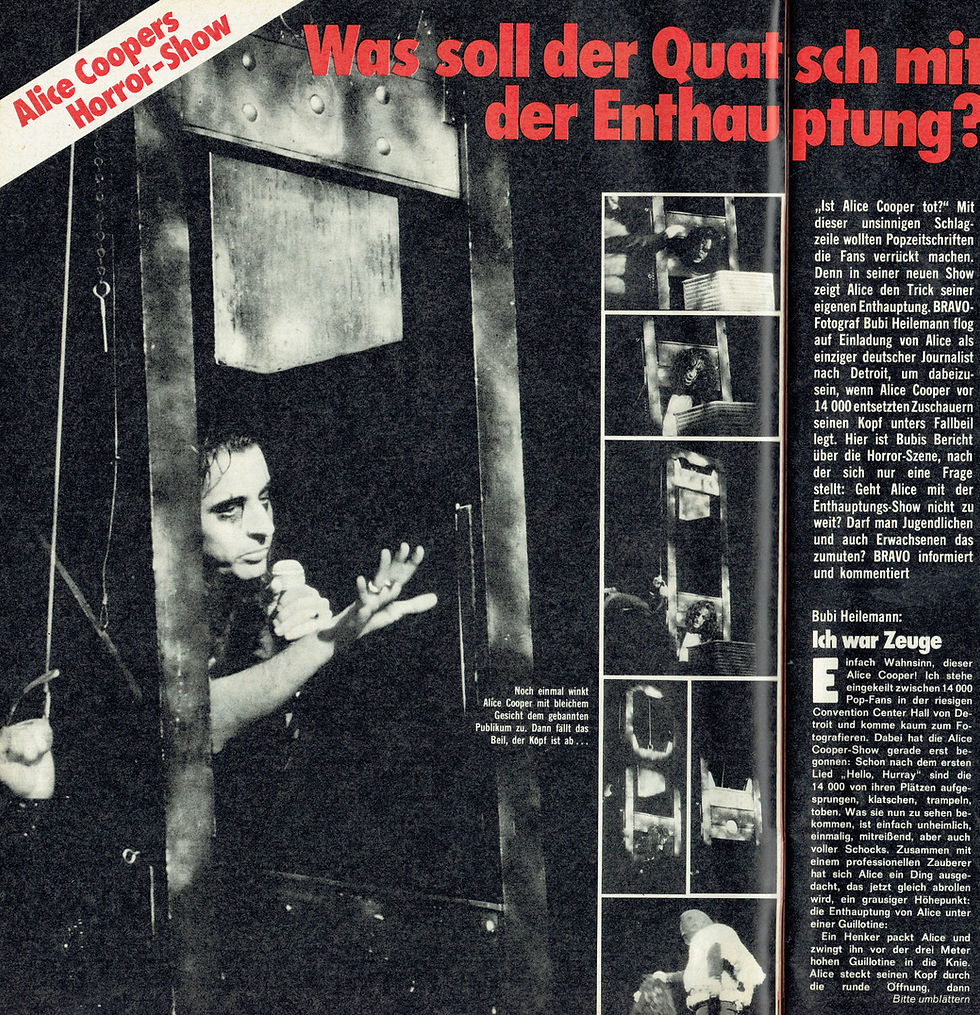
• A dramatic recounting of the guillotine routine, including the moment the blade drops and the “severed head” is displayed.
• Commentary sections debating the ethics of stage horror and its impact on young audiences.
• A photograph of Alice Cooper with photographer Bubi Heilemann, anchoring the article in Bravo’s signature pop‑reportage style.
• Layout typical of early‑’70s Bravo: bold typography, moral framing, and a mix of reportage and opinion.
The Story Behind It
By June 1973, Alice Cooper’s stage show had become a global talking point. This Bravo feature captures the European reaction to his nightly “execution,” describing the guillotine sequence in breathless detail: the wooden clamps, the rising tension, the blade’s fall, and the reveal of the lifelike severed head.
Bravo emphasises that the danger is real — the blade is sharp, the guillotine functional, and Cooper’s head genuinely beneath it until the last second. Alice himself admits the scene unnerves him: he loves theatre, he loves provocation, but he knows the risk.
The article then shifts into a moral debate: • Is it acceptable to show simulated death on stage? • Does it reflect the cruelty of the world, or is it simply exploitation? • Should young audiences be exposed to such imagery?
Bravo includes opinions from fans, cultural commentators, and Cooper’s own mother — who insists that Alice is “a clown and an actor,” performing within a world that is itself a stage. The feature ultimately portrays Cooper as a provocateur whose art forces audiences to confront fear, humour, rebellion, and the boundaries of entertainment.
Related Material
• Alice Cooper (May 24 1973) Alice’s New Horror Show – Bravo Feature
• Alice Cooper (May 10 1973) Inside Alice – Feature
• Alice Cooper (June 30 1973) Hype Hype Hooray – NME Feature
• Additional entries listed in the scrapbook tag index
Source Details
Publication: Bravo Magazine Date: June 7 1973
Format: Two‑Page Report / Stage‑Act Commentary
Provenance Notes: Original German youth‑press coverage analysing Alice Cooper’s guillotine routine and the cultural debate surrounding theatrical horror in 1973.
Bravo Magazine, June 7, 1973
A two‑page Bravo report offering reactions and opinions on Alice’s ongoing “game with death,” including his notorious wooden‑gallows stage routine, framed through the magazine’s vivid, youth‑press lens.
Alice Cooper Group’s "Horror?," a two-page article in Bravo Magazine, June 7, 1973.
Report and opinions on Alice's game with death
Wooden clamps close around his neck. He can no longer escape. Three meters above him hovers the sharp-edged iron that is to behead him. Breathless silence in the hall. Music swells like never before.
Slowly, the executioner takes the rope in his hand, which triggers the guillotine. Once again, Alice looks palely at the audience. Then a tug on the rope. The knife whizzes down. Full light falls on the scene as Alice's severed head falls into the basket. A cry goes through the Convention Hall as the executioner takes Alice's bleeding, pale head from the basket and holds it out to the audience. It takes minutes
Alice Cooper with Bubi Heilemann
until the fans realize that Alice is alive, that it was all just a gruesome gag
But the beheading scene is not without danger for Alice. The guillotine is real, the knife sharp. Alice really has her head underneath it. Only: At the moment the guillotine comes swirling down, Alice can quickly duck her head into a cavity beneath it.
A wooden block prevents the knife from thundering in there. The severed head is a lifelike plastic replica. But the trick sends a shiver down even Alice's spine every time: "That scene makes me feel pretty uneasy. Everything about it is real, except for the bit of wood between my head and the sharp knife! But I love this kind of theater. I want to provoke the audience. As evil as possible. I'm not a preacher, I'm an entertainer."
"Pretty heavy," said a girl next to me in Detroit, and that means: A scene like that really moves you
But can one subject an audience to such horrific scenes? Is it permissible to play with the horror of death on stage?
Horror with a Question Mark
"If the beheading scene in Alice Cooper's new show is meant to reflect the cruelty of the world, then I have nothing against his stage horror. But if he's only doing it to make money, then he's playing a dangerous game with the emotions of young people. I'm of the opinion that people go to a concert or a theater to be entertained. But then to have to see such horrific things on stage...? Certainly, there are many young people and adults who enjoy going to Dracula films. Some of these films are perhaps even bloodier than Alice Cooper's show. However, I think that anyone who watches something like that must be morally sound. Only then will they not react aggressively to what they see."
Protest against "the old"
"In our society, every kind of music reflects what an entire class of people likes, what they profess, how they would like to be. Alice Cooper is simply resisting the world of adults, in which everything seems to be so orderly. That's precisely why adults find him so unsavory, perverse, and crazy. The young people who like Alice and his music show disagree. They think it's good that he makes fun of school, money, and now death. In reality, every sensible young person will know full well that having fun with horror and making fun alone is not enough to cope with life, problems, and death."
Alice's mother also saw her son's show in Detroit. Mustn't she have been particularly horrified? For many fans, the beheading scene was nothing more than a thrill. But can a mother bear to watch her son, if only for fun, put his head under the guillotine and have it chopped off as a gag?
BRAVO spoke to Alice's mother:
He's just acting
"For a moment, I thought Alice had really had herself beheaded. For a moment. But I know that Alice always wanted to shock and provoke people. He did that as a child, and now he does it even more, and sometimes people ask me: Is your son crazy? How can he walk around in that outfit? How can he perform with a snake? How can he hang himself one time and behead himself the next? They don't understand that for Alice Cooper, the world is a big theater in which everyone plays their role as best they can. And Alice is a clown and an actor.
Copyright Notice
All original magazine photographs, artwork, and text remain the property of their respective copyright holders. This scrapbook entry is a transformative, non‑commercial archival summary created for historical documentation and educational reference


Comments