


Mick Ronson (May 11, 1974) To Hull and Back – New Musical Express
Updated: 2 days ago
MICK RONSON |
The feature opens with Murray’s wry introduction, describing Hull as the last place he wanted to visit — yet the perfect setting to capture Ronson’s grounded character. The piece traces Ronson’s journey from his time as David Bowie’s guitarist and arranger to his emergence as a solo artist. It highlights his modest personality, technical brilliance, and the contrast between his fame and his Hull upbringing. The accompanying photograph shows Ronson performing live, guitar in hand, dressed in metallic stagewear, symbolising his blend of glam style and working‑class authenticity. |
FEATURE HIGHLIGHTS
FEATURE | DETAILS |
Writer: | Charles Shaar Murray |
Artist: | Mick Ronson |
Date: | May 11, 1974 |
Publication: | New Musical Express |
Country: | United Kingdom |
Section / Pages: | Pages 16–17 |
Title: | To Hull and Back |
Event: | Mick Ronson profile and interview |
Era: | 1974 – Post‑Spiders From Mars period |
Tone: | Reflective, humorous, and insightful |
Photography: | Live performance image of Ronson with guitar |
Audience: | UK rock readers and Bowie‑era followers |
Event: | Mick Ronson feature and live performance coverage |
Era: | 1974 |
Tone: | Warm and observational |
Photography: | Ronson performing on stage in metallic attire |
Audience: | NME readers and glam‑rock enthusiasts |
ORIGINAL SOURCE MATERIAL
PAGE 1 | PAGE 2 |
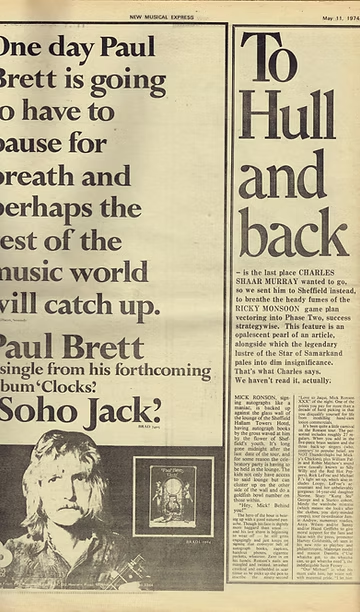 [MICK RONSON – MAY 11, 1974] |  [MICK RONSON – MAY 11, 1974] |
THE STORY & CONTEXT
THE STORY BEHIND IT | CONTEXT AND NOTES |
After his celebrated work with David Bowie, Mick Ronson embarked on a solo career marked by both creative freedom and personal introspection. Charles Shaar Murray’s article captures this transitional moment, portraying Ronson as a musician balancing fame with humility. The feature situates him within the broader landscape of British rock, where regional identity and artistic ambition intersect. | This article exemplifies NME’s mid‑70s editorial style — sharp, literate, and personality‑driven. It reflects the publication’s fascination with post‑Bowie narratives and the evolution of glam musicians into independent artists. The inclusion of the Paul Brett advert on the facing page situates Ronson within the broader British rock scene of the time. |
COPYRIGHT & ARCHIVAL USE |
All magazine scans, photographs, and original text excerpts remain the property of their respective copyright holders. This Chronicle entry is a transformative, non‑commercial archival summary created for historical documentation and educational reference. No ownership of the original material is claimed or implied. |
Comments