


🔘 Seven Seas of Rhye – Single: Feb 1974
- Queen
- Feb 25, 1974
- 3 min read

Queen’s breakthrough UK hit — their first Top 10 single, launching them into the mainstream.
🔘 – Overview
Released in the UK in late February 1974, Seven Seas of Rhye became Queen’s first major chart success, marking the moment the band broke through to a national audience. Issued on EMI (EMI 2121), the single arrived just ahead of the release of Queen II, with the A‑side serving as the album’s dramatic closing track — a fully realised version of the instrumental sketch that had appeared on their debut LP.
The single’s release date has long been the subject of collector debate. Promotional copies were stamped 25 February 1974, while The New Singles listed 22 February 1974, and retail copies are widely documented as 23 February 1974. Regardless of the exact day, the record entered the UK charts on 9 March 1974, beginning a ten‑week run that would carry it to a peak of No. 10 — Queen’s first appearance in the Top 10.
Produced by Roy Thomas Baker and the band themselves, the track showcased Queen’s early blend of glam, hard rock, and theatrical flair. The B‑side, See What a Fool I’ve Been, written by Brian May, was a blues‑inspired reworking of a song he had performed years earlier with Smile. Both tracks were published by Feldman and Trident Music, reflecting the band’s early association with Trident Studios.
Pressed by EMI Records, the single appeared in several UK variants, including solid‑centre, push‑out centre, promo copies, and a rare white‑label test pressing. Its success helped establish Queen as one of Britain’s most exciting new rock acts, setting the stage for the explosive run of hits that would follow later in 1974.
🔘 – Track List
UK 7" Single — EMI – EMI 2121 — 1974
Side A
Seven Seas of Rhye
Written by Mercury
Produced by Roy Thomas Baker, Queen
Side B
See What a Fool I’ve Been
Written by May
Produced by Roy Thomas Baker, Queen
🔘 – UK Variants
7", 45 RPM, Single — EMI – EMI 2121 — UK — 1974
7", 45 RPM, Single, Solid Centre — EMI – EMI 2121 — UK — 1974
7", 45 RPM, Single, Promo — EMI – 2121 — UK — 1974
7", Test Pressing, White Label — EMI – none — UK — 1974
🔘 – Chart Performance
UK — Official Singles Chart
Peak Position: 10
Weeks on Chart: 10
Chart Run (09/03/1974 → 11/05/1974)
45 — 09/03/1974
30 — 16/03/1974
15 — 23/03/1974
15 — 30/03/1974
11 — 06/04/1974
10 — 13/04/1974 (Peak)
14 — 20/04/1974
17 — 27/04/1974
36 — 04/05/1974
50 — 11/05/1974
🔘 – Context & Notes
• Queen’s first UK Top 10 single
• A‑side taken from Queen II
• B‑side based on an old Smile‑era blues arrangement
• Produced by Roy Thomas Baker and Queen
• Published by Feldman / Trident Music
• Pressed by EMI Records
• Promo copies stamped 25.2.74
• The New Singles listed 22 February 1974
• Widely documented retail release: 23 February 1974
• Early example of Queen’s glam‑rock period
🔘 – Visual Archive
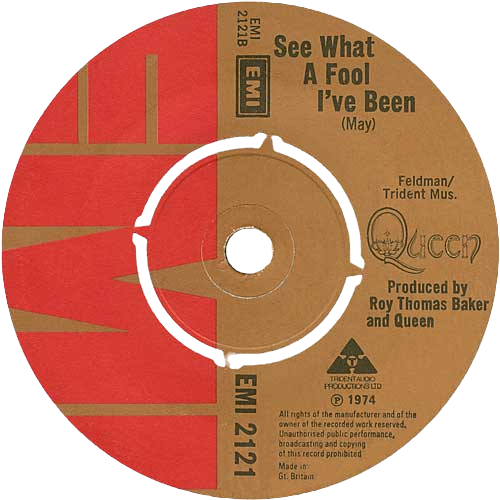
UK EMI 2121 7" single, four prong commercial issue label.
Queen’s Seven Seas of Rhye (1974), EMI 2121 — the band’s first UK Top 10 hit.
🔘 – Related Material
• Queen II (1974)
• “Killer Queen” (1974)
• “Liar” (1974)
• Early Queen singles & Trident era
🔘 – Discography
Keep Yourself Alive — 1973
Liar — 1974
Seven Seas of Rhye — 1974
Killer Queen — 1974
🔘 – Mini‑Timeline
✦ 22–25 Feb 1974 — Release window (promo + retail)
✦ 09 Mar 1974 — Enters UK chart at No. 45
✦ 13 Apr 1974 — Peaks at No. 10
✦ 11 May 1974 — Final chart week
🔘 – Glam Flashback
With its dramatic piano stabs, layered harmonies, and theatrical flair, Seven Seas of Rhye marked the moment Queen stepped out of cult status and into the British mainstream — the first spark of the chart‑dominating force they would soon become.
🔘 – Closing Notes
A landmark early single, Seven Seas of Rhye remains a fan favourite and a key turning point in Queen’s rise to global fame.
🔘 – Sources
Discogs
45cat
🔘 – Copyright
All original text and images remain the copyright of their respective publishers and creators.
Presented for historical, educational, and archival purposes.


Comments