


📰 Slaughter on Tenth Avenue - Album Review: Mar. 1974
- Mick Ronson
- Mar 2, 1974
- 5 min read
Updated: Mar 2
A strong debut from Bowie’s right‑hand guitarist, praised by NME for its range, confidence, and sharp production.
NME hails Ronson’s debut LP as a promising, varied, and musically assured statement from one of glam rock’s defining guitarists.
📰 Key Highlights
• One‑page album review in New Musical Express, March 2, 1974
• Praises Ronson’s versatility as guitarist, arranger, and vocalist
• Highlights standout tracks “Pleasure Man” and “Hey Ma Get Papa”
• Notes the album’s stylistic range and strong production
• Frames Ronson as more than Bowie’s sideman — an artist in his own right
📰 Overview
At the height of the Ziggy Stardust era’s afterglow, Mick Ronson stepped forward with his debut solo album, Slaughter on Tenth Avenue. NME’s review positions the record as a confident, musically varied statement from a guitarist long celebrated for his work with David Bowie. The piece emphasises Ronson’s ability to move beyond the shadow of the Spiders from Mars and establish his own artistic identity.
📰 Source Details
Publication / Venue: New Musical Express
Date: March 2, 1974
Issue / Format: Album review
Provenance Notes: Sourced from original print clipping.
📰 The Story
The NME review opens by calling Slaughter on Tenth Avenue a “promising debut from a young guitarist,” immediately framing Ronson as an emerging solo force rather than merely Bowie’s celebrated sideman. The reviewer praises the album’s musical breadth — from the swaggering rock of “Pleasure Man” to the theatrical flair of “Hey Ma Get Papa,” noting the latter’s lyrical bite and Ronson’s ability to balance humour with intensity.
The production is highlighted as crisp and dynamic, showcasing Ronson’s strengths not only as a guitarist but as an arranger and vocalist. The review draws attention to the album’s shifts in tone and texture, suggesting that Ronson’s musical instincts extend far beyond glam rock’s expected palette.
While Bowie’s influence is acknowledged — an inevitable comparison given their intertwined careers — the review stresses that Ronson’s debut stands firmly on its own merits. It presents him as a musician capable of stepping into the spotlight with confidence, versatility, and a distinctive artistic voice.
📰 Visual Archive

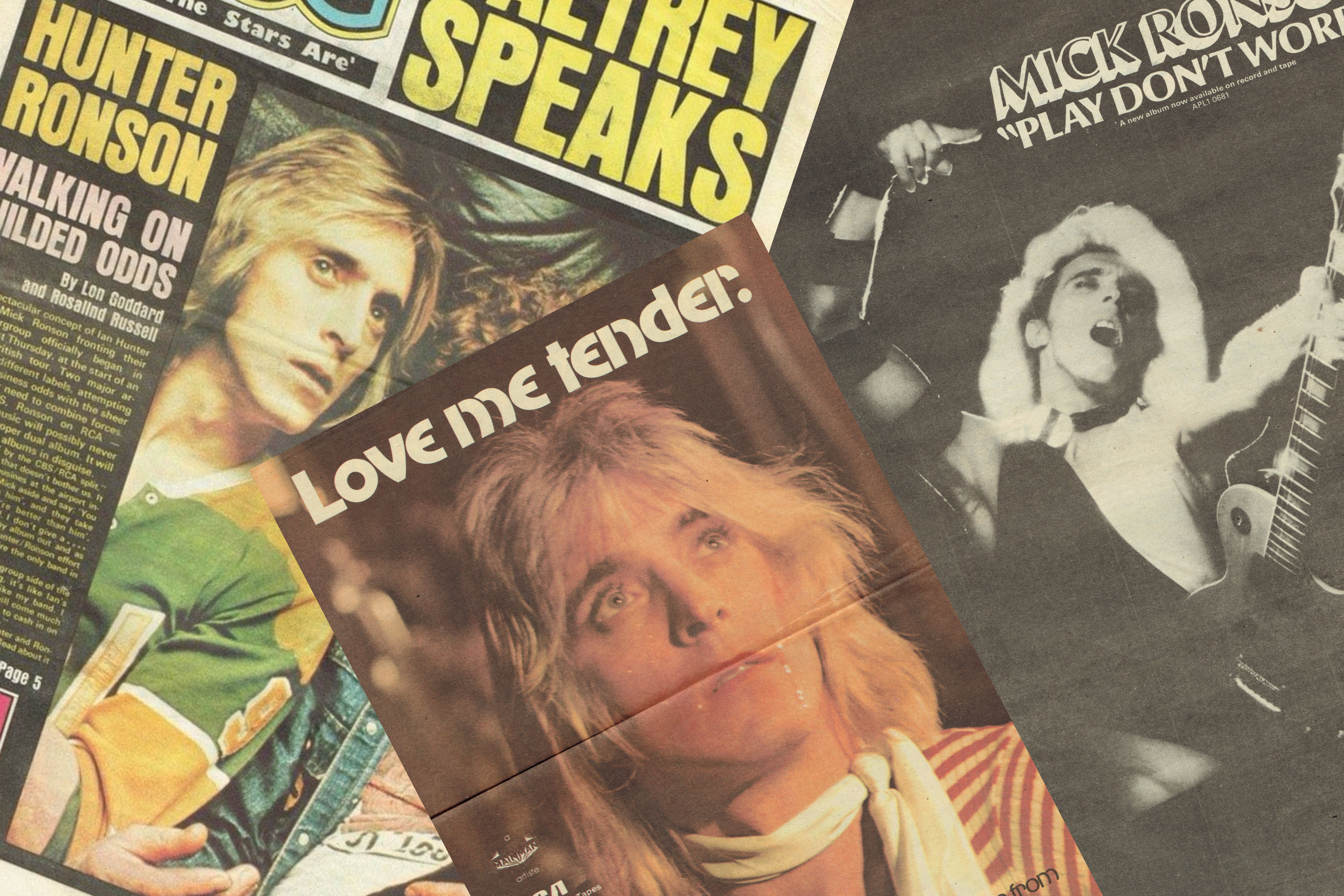
NME’s March 2, 1974 review of Mick Ronson’s debut album Slaughter on Tenth Avenue.
📰 Related Material
Explore the tags below for connected posts and themes.
📰 Closing Notes
This review captures a pivotal moment in Ronson’s career — the point where he began to carve out his own artistic identity beyond the Bowie universe, earning critical respect for his range and musical intelligence.
📰 Sources
• New Musical Express, March 2, 1974
• Contemporary Bowie/Ronson press archives
• Secondary commentary from glam‑era retrospectives
📝 Copyright Notice
All magazine scans, photographs, and original text excerpts referenced in this entry remain the property of their respective copyright holders. This Chronicle entry is a transformative, non‑commercial archival summary created for historical documentation and educational reference. No ownership of the original material is claimed or implied.
MICK RONSON: "Slaughter On Tenth Avenue" (RCA) New Musical Express
WHATEVER HAPPENED or didn't happen at the Rainbow last Friday, there's no getting round the fact that "Slaughter On Tenth Avenue" is a fine, fine album. It's varied, self-assured, musically and thoroughly exciting. As well as taking care of the guitars and voices, Mick's right in there producing, arranging, conducting, mixing and writing the melodies for three of the tracks, and he doesn't let up anywhere. With the exception of "Love Me Tender", which sounds rather uncomfortable, "Slaughter On Tenth Avenue" is solidly excellent.
The album's main revelation is Ronno The Voice.
Does he sound like Bowie? Occasionally. Does he sound like any other specific individuals? No, he doesn't. Does he sing good? Definitely. It's a very cool voice, not yet as powerful as it'll get when he's gotten used to singing, but his phrasing is admirable and his feel for lyrics is quite noteworthy. Watch that quaver, though.
One major surprise is that, far from making a "guitarist's album", he's leaned over so far in the opposite direction that there isn't even a solo until half-way through the second side. It crops up during "Pleasure Man"/"Hey Ma Get Papa", eight minutes and fifty-five seconds of the best music of 1974.
"Pleasure Man" is co-written by Ronno and an unidentified flying Richardson, while "Hey Ma Get Papa" matches Ron-no's music to a Bowie lyric. Anyway, about halfway through "Pleasure Man", Mike Garson plays a solo that sounds like the musical equi-valent of a breaking window filmed in slow motion while Ronson's Les Paul screams like a lost soul, like something out of H.P. Lovecraft.
Then the song goes into this swaggering riff before the rhythm section collides with a ten-ton lorry and Ronson's guitar moans and squitters in the darkness until the ARP intro to the startlingly McCart-3 neyish "Hey Ma Get Papa" pirouettes out of the right speaker to rescue it.
If that ain't enough to banish any lingering doubts about Mick Ronson's credentials as a musician in his own right, then you've got a very bad case of ingrowing eardrums.
Back on side one, "Love Me Tender" is followed up by the new Bowie song "Growing Up And I'm Fine" which bounces around like a pinball machine, and would've been a far superior single to "Love Me Tender".
"Only After Dark" is the B-side of the single, and it boasts a nice riff, some fine per-cussion effects and more of the Sensuous Tonsils.
"Music Is Lethal" is a heavingly melodramatic neo-Brel tune written by an Italian gen-tleman named Battiste. Ronno's assistant Susie translated the lyrics into English and Mr. Bo-wie tarted up the translation. Despite a strong lyrical resemblance to "Amsterdam" (I can't take that line about "mulatto hookers and cocaine bookers" seriously) it works because of the strength of the arrangement and Ronno's subtle, expressive vocal.
Flip it over and you're straight into a rocking version of Annette Peacock's "I'm The One". Garson was in on the original recordings, and it's really his track. Through the already-eulogised "Pleasure Man"/"Hey Ma Get Papa", and we're into the title toon, the old George Gershwin chest-beater, on which Mick really wails, as we say in the trade.
Apart from Mick and the admirable Garson, there's Ayn-sley Dunbar on drums and Trevor Bolder on bass, trumpet and trombone. They used to call him "Trumpets" Bolder back in Hull, and his brass fills on "Pleasure Man" are un-obtrusive but useful. Dunbar is as monstrous as ever.
There you have it. The best album to have entered my home so far this year, and well worth the price of admission.
It's a pity that they didn't use the killer version of "White Light White Heat" that they cut at the Chateau, but it's some-thing to look forward to on the next one. In fact, I'm already looking forward to the next one. And the one after that.
Not bad for a promising young guitarist from Hull.


Comments