


Alice Cooper (Group) (June 5, 1971) “Sex, rock and a boy called Alice” – Feature / Interview – UK Music Press
Updated: 2 days ago
ALICE COOPER |
In-depth early UK feature on the Alice Cooper band, exploring their provocative stage theatrics, use of shock imagery, the controversy surrounding their name and androgynous look, and their rising notoriety in the rock scene. |
FEATURE HIGHLIGHTS
FEATURE | DETAILS |
Date: | Week ending June 5, 1971 (on sale Friday) |
Country: | United Kingdom |
Section / Pages: | Full Feature (likely Melody Maker or Disc & Music Echo) |
Title: | Sex, rock and a boy called Alice |
Event: | In-depth Band Interview & Profile |
Era: | Love It to Death / Early Shock-Rock Breakthrough (1971) |
Tone: | Provocative, curious, slightly scandalized |
Photography: | Large group portrait with Alice Cooper front and center in full glam/shock makeup and costume, band members surrounding him |
ORIGINAL SOURCE MATERIAL
PAGE 1 | PAGE 2 |
 [ALICE COOPER – GROUP] |  [ALICE COOPER – GROUP] |
PAGE 3 | PAGE 4 |
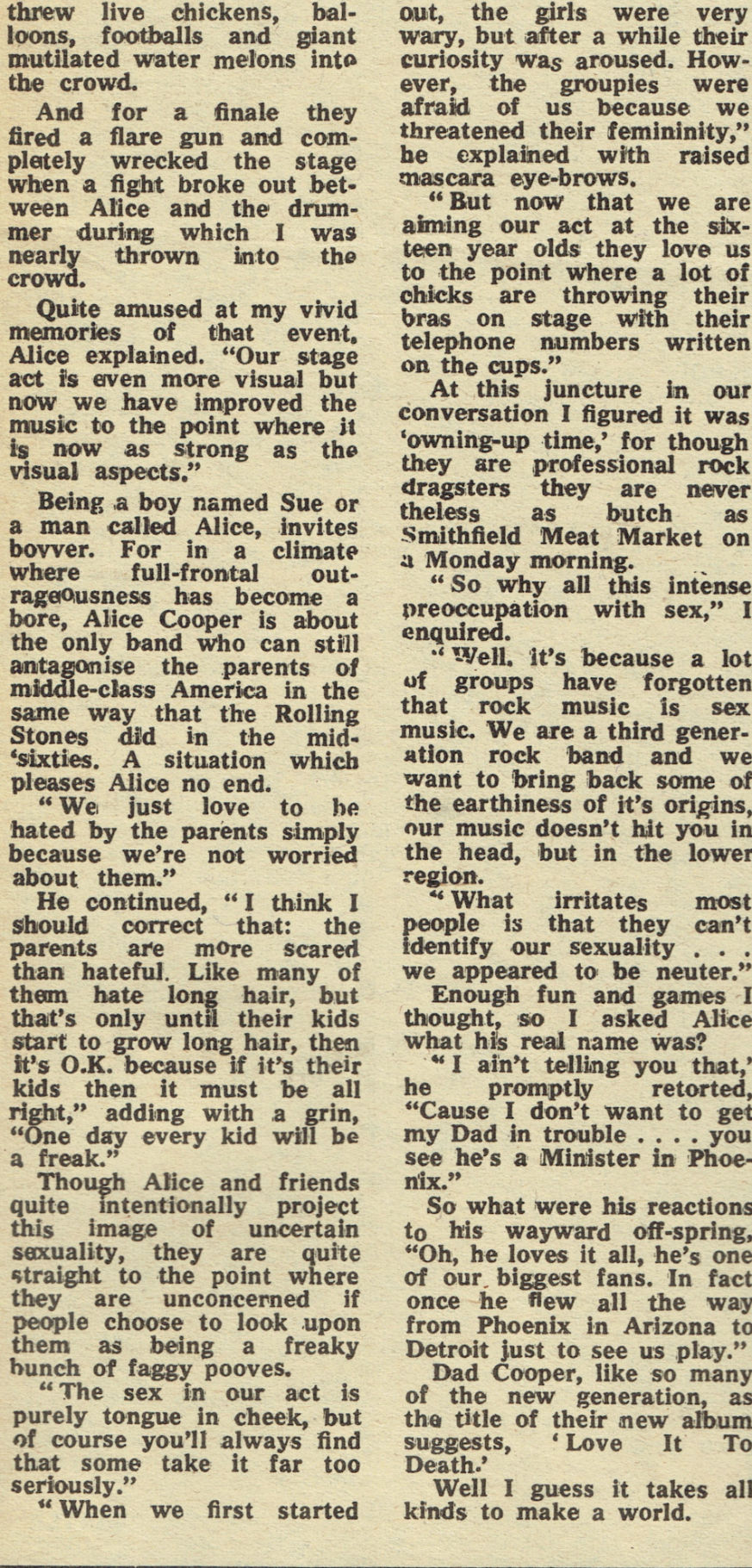 [ALICE COOPER – GROUP] | [ALICE COOPER – GROUP] |
PAGE 5 |
[ALICE COOPER – GROUP] |
THE STORY & CONTEXT
THE STORY | CONTEXT AND NOTES |
The article profiles the group, centered on vocalist Alice Cooper, discussing their outrageous live shows involving thrown objects (chickens, watermelons), fake blood, makeup, and theatrical violence. It addresses public reactions to their “freaky” image, questions about sexuality and androgyny, and how the band (all using the Alice Cooper name at the time) positioned themselves as a reaction to mainstream culture. Alice explains their intent and the evolution of their visual and musical style. | This piece captures the Alice Cooper Group during their breakthrough Love It to Death era (released early 1971), when they were first gaining major attention in the UK for their shock-rock performances. It reflects the mix of fascination and moral panic their act provoked in the early 1970s music press. The band was still operating as a collective under the shared name. |
FEATURE HIGHLIGHTS
“Is Alice a boy or a girl?”
WHAT THE CLIPPING SHOWS
Two-page (or spread) feature with a bold, eye-catching headline, dense interview text, and a prominent black-and-white band photograph. Classic early-70s UK music weekly layout with tabloid-style sensationalism balanced by serious rock journalism.
RELATED MATERIAL
RELATED MATERIAL | RELATED MATERIAL |
• Alice Cooper (Group) (June 17, 1972) “Alice here for one gig” – Melody Maker (UK) | • Alice Cooper (Group) (June 17, 1972) Final Killer Performance Advertisement – Melody Maker (UK) • Alice Cooper (Group) (1971) Love It to Death Album & Tour Coverage |
COPYRIGHT & ARCHIVAL USE |
All magazine scans, photographs and original text excerpts remain the property of their respective copyright holders. This entry is a transformative, non-commercial archival summary created for historical documentation and educational reference. |


Comments