


🔘 The Genesis Bag – Feb 10, 1973
- Genesis
- Feb 10, 1973
- 7 min read
Updated: Feb 10
New Musical Express – One‑Page Article
🔘 Overview
In February 1973, Genesis were touring Britain with a renewed sense of identity and ambition. While Peter Gabriel’s theatrics had become a visual signature, this NME feature argues that the band’s true strength lay in the interplay between its musicians — particularly Tony Banks and Phil Collins — and the evolving sophistication of their sound. The article captures a group on the cusp of wider recognition, navigating audience expectations, internal dynamics, and the strange contradictions of early‑70s rock culture.
🔘 Source Details
Publication: New Musical Express
Date: February 10, 1973
Issue Context: One‑page feature
Provenance Notes: Transcribed from original newsprint; sourced from your working draft in the Wix editor.
🔘 The Story
Genesis entered 1973 with a growing reputation for theatricality, complexity, and a kind of eccentric English mystique. While Peter Gabriel’s stage presence drew attention, Tony Banks makes clear in this interview that the band’s identity was always collective — shaped by shared classical influences, long‑standing friendships, and a refusal to compromise their musical direction.
The article explores their origins at Charterhouse, their early struggles, and the turning point marked by Trespass and their signing to Charisma. It also highlights their unexpected popularity in Italy, their ambivalent reception in England, and the challenges of being perceived as either too intellectual or too strange.
Banks speaks candidly about the Mellotron, the band’s writing process, and the misconceptions surrounding Gabriel’s role. What emerges is a portrait of a group determined to be understood on their own terms — musically adventurous, theatrically bold, and quietly confident in their trajectory.
🔘 Key Highlights
Genesis’ 1973 UK tour opens at London’s Rainbow Theatre.
Tony Banks discusses the band’s classical roots and early development.
Trespass identified as their first truly “worthwhile” album.
Strong Italian fanbase contrasts with lukewarm UK reception.
Peter Gabriel’s theatrics seen as necessary but not definitive.
Mellotron described as central to the band’s evolving sound.
Banks doubts Genesis will ever be “massive” in England — but sees America as a real possibility.
🔘 Article Text
RAINBOW/FRIDAY; EXETER/WEDNESDAY

THE GENESIS BAG
For those who have ears as well as eyes, the current British tour by Genesis, which opened at London’s Rainbow Theatre on Sunday, should prove conclusively that it’s not just the singer but the song which makes this a band “most likely” in ’73.
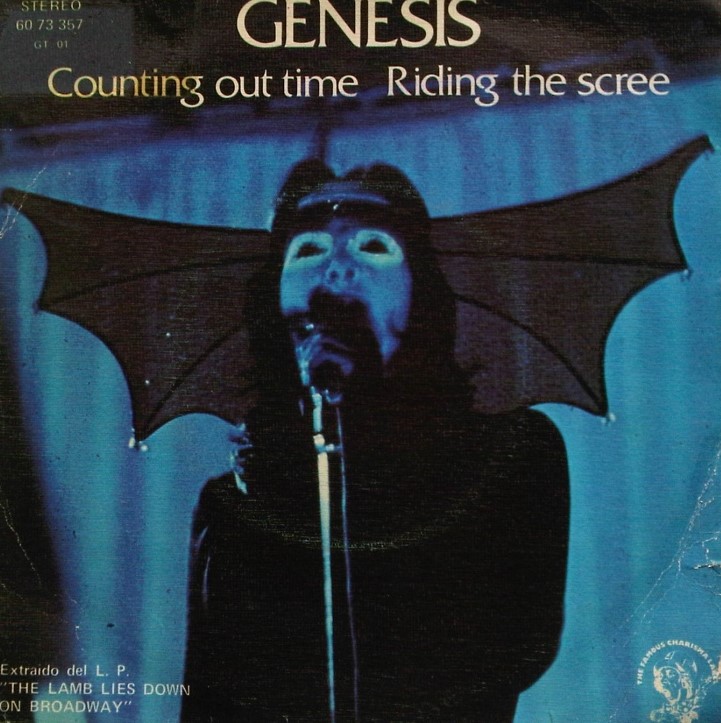
No one — least of all Genesis — would dispute the impact that Peter Gabriel’s effective theatrics have had in focusing attention on the group, but now is the time to take into consideration their other musicians like drummer Phil Collins and organist/Mellotronist Tony Banks.
Speaking to Tony last week at Charisma Records, I found him to be a polite but curiously laid‑back product of a public school education and classically trained musical mind. He describes himself as “not a natural for this business” and only got into the group on leave of absence for one year from Sussex University, where he was studying a combination of maths and philosophy. That was three years ago, and the leave became permanent.
Along with the other founder‑members of the group, Tony got his grounding at Charterhouse School in Godalming and made the transition from classical piano to more contemporary sounds inspired by the likes of Alan Price — who was high in the charts with the Animals’ “House of the Rising Sun” — and more especially Mike Pinder, who was pioneering the Mellotron with the Moody Blues. The three founder members, Tony, Mike Rutherford and Peter Gabriel, have been playing together now for almost a decade.
Genesis as a recording entity have been together now for over three years from the original release of their Decca Revelation album, when they worked under the auspices of the awesome Jonathan King.
“Jonathan was really quite kind and he liked our songs and didn’t try to influence us,” recalled Tony. “I don’t think we’d really sorted out a direction at that time, though, and we were still rather amateurish in the studio.”
As far as the group now are concerned, the first album which they felt worthwhile was Trespass, their first recording on the Charisma label.
“It was really a labour of love at the time,” said Tony. “We were living, eating and sleeping our music. It was an immensely satisfying period for us when we were on the road and determined not to make a compromise of any kind. We wanted to achieve the same kind of success in the same kind of way that bands like Family had — the reputation for just making a name by playing to people and avoiding exploitation or any individual trips.”
“I don’t think we will ever be really massive in England — it would have happened before if it was going to happen at all.”
“Really, Peter’s emergence as a spokesman and focal point is something that we only came to terms with recently when we realised that it was essential to get some sort of attention for the group by pushing in one direction. It was necessary in order to make the transition from just being another band to something different, but I think we all regret having had to do it.”
“We wanted to provoke our audience into some kind of positive reaction about what we were doing. Peter’s theatrics have helped produce that sort of response while being an extension of the music or lyrics.”
“That was why we brought about that situation in Aylesbury where we invited everyone to boo instead of clap. It gave them something to do which was not just a considered, automatic, and politely preconceived response.”
“It backfired slightly when we got a section of boo‑boys following us about — full of good intentions but somewhat disconcerting. We weren’t looking for that reaction every night.”
Perhaps if there is one word which sums up Genesis’ unique musical contribution — both musical and theatrical — it is “weird”. Like any group who have something new going for them, they have a small circle of supporters on the lunatic fringe who are under the impression that Gabriel is some sort of tripped‑out hermaphrodite‑spiritualist solely responsible for their imaginative lyrics.
“Again, I suppose it’s inevitable that someone we have consciously pushed up front should receive most of the credit in the press, but contrary to popular opinion, Peter does not write all our lyrics. We all get a credit because we all contribute.”
“People place all kinds of interpretations on our songs, but I think that’s healthy; it shows some kind of thinking contribution on their part. Someone came up to me and told me they thought that ‘White Mountain’ was all about the Russian Revolution. I said, ‘That’s it. The Russian Revolution — that’s what it’s all about.’”
“Some of my writing, like ‘Watcher of the Skies’, was inspired by my liking of science fiction. That particular song was a combination of Arthur C. Clarke’s Childhood’s End and Marvel Comics, who produced a third character — the Watcher.”
One of the most significant facts about Genesis is that there is no apparent bag into which they will comfortably fit, although Tony feels that musically they are probably better understood approached from a classical direction.
He believes that the band’s almost fanatical following in Italy (where Foxtrot has been a number‑one album for some months) and the regular smash attendance figures may illustrate the point.
“It is, after all, a country rich in its classical history, and young people are accustomed to that sort of music without even being aware that it is constantly around them. I think we are best listened to as a rock band but with classical music in mind.”
“We find it incredibly confusing that we have such a vast following in one place but so little in other places — like Germany, for example. Another reason for the Italian reaction may be that our music is built out of contrasts, and Italy is a country of political contrast. You couldn’t have ideologies more clearly opposed than Communism and Fascism.”
“Personally, I don’t ever think we will be really massive in England. I think it would have happened before now if it was going to happen — but America is somewhere it could break really big for us, and that, in turn, might have an effect here.”
“It’s a strange audience in England and there are some contradictions involved. For example, a lot of people think we are very big on the university circuit. We’re not — never have been. Universities are a strange audience; they tend to over‑intellectualise then over‑compensate for the sake of simplicity. I remember the only things I ever got into at Sussex were the Incredible String Band and Leonard Cohen.”
“Colleges have been quite good for us, but it’s very difficult to pinpoint our public in this country (except for those who insist on shaving their heads, of course). We discovered, for example, that the people who liked Lindisfarne liked us, and then again I’ve found out that quite a few Black Sabbath fans enjoy Genesis. I would have thought the two incompatible.”
Tony’s keyboard work within the framework of Genesis is an indispensable part of their overall sound, and indeed in many cases his use of the much‑underestimated Mellotron provides the key to their musical identity.
“Essentially it’s the sound and the power of the Mellotron I enjoy so much,” said Tony. “In many ways it is a very limited instrument in that you cannot physically play fast upon it, and it is usually at its most effective used sparsely for dramatic effect.”
“It was Mike Pinder of the Moodies who first really brought home to me its real value. You listen to his work with the Moodies, particularly on their early albums, and you will find he’s never intrusive or overwhelming but always there providing just the right touch at the right moment.”
“The only other person I’ve ever heard who sounded as though he knew what the potential was was Ian McDonald, who played it on the first King Crimson album.”
“For example, I’d never use the instrument to replace a string passage. The Mellotron is a sound and an instrument in its own right. It can reproduce accordion or harmonium effects, but that is not how it should be thought of — not as substitutes for other things. My favourite instrument is, in fact, the grand piano.”
Tony now feels the time is arriving when Genesis will get recognition as a band and not merely a backing group for Peter Gabriel — which, of course, Peter has never held them to be. But it is time to sit back and listen to Genesis as well as watch with interest.
ALTHAM
TONY BANKS: Science Fiction
🔘 Closing Notes
This article captures Genesis at a pivotal moment — still cult, still strange, still searching for their audience, yet already laying the groundwork for the era that would define them. It’s a reminder of how their blend of classical influence, theatrical ambition, and quiet determination set them apart from every other band of their generation.


Comments