


📰 Hot Love - Single Review: Mar. 1971
- T.Rex

- Mar 5, 1971
- 6 min read
Writer: Jackie Hearn / Fulham Chronicle
Date: March 5, 1971
Length: 3–4 min read
A lively, upbeat regional‑press review celebrating T. Rex’s follow‑up to “Ride a White Swan,” capturing the excitement surrounding Marc Bolan’s sudden rise from cult mystic to chart‑storming pop force.
A London reviewer hears Bolan’s new single as a joyous return to classic rock ’n’ roll.
Jackie Hearn praises “Hot Love” as an instantly commercial, irresistibly nostalgic burst of rock ’n’ roll energy. Drawing comparisons to Little Richard and Elvis, the review frames the single as a confident step forward for T. Rex — and a likely chart contender.
📰 Key Highlights
• Review of T. Rex’s single “Hot Love”
• Notes the simplified band name after Tyrannosaurus Rex
• Praises the single’s rock ’n’ roll roots
• Compares Bolan’s sound to ’50s icons
• Highlights the value‑for‑money B‑side pairing
📰 Overview
By early 1971, Marc Bolan had completed his metamorphosis from underground folk mystic to emerging pop star. “Ride a White Swan” had already cracked the charts, and “Hot Love” arrived as its swaggering successor — a single that would soon ignite the glam‑rock era.
The Fulham Chronicle’s review captures this moment with enthusiasm. Jackie Hearn frames the name change from Tyrannosaurus Rex to T. Rex as a welcome simplification, then dives into the music itself: a joyous, retro‑infused rocker that channels the spirit of early rock ’n’ roll. The review positions “Hot Love” as both nostalgic and fresh, a perfect blend for a singles market in need of revitalisation.
This makes the piece a valuable snapshot of how London’s local press received Bolan’s breakthrough moment.
📰 Source Details
Publication / Venue: Fulham Chronicle (Hammersmith, London)
Date: 5 March 1971
Format: Singles Review Column
Provenance Notes:
• Based on a surviving newspaper clipping
• Only the T. Rex portion used
• Summary only — no copyrighted text reproduced
📰 The Story
Jackie Hearn opens with a playful admission: spelling “Tyrannosaurus” was always a challenge, and the band’s decision to shorten their name to T. Rex is a welcome relief. This light tone sets the stage for a warm, enthusiastic review.
Hearn praises “Ride a White Swan” as a breakthrough moment, then declares “Hot Love” even better — a return to the raw, joyous energy of ’50s rock ’n’ roll. The comparisons to Little Richard and Elvis underline the single’s rhythmic drive and vocal swagger, while the emphasis on its instant commercial appeal reflects the growing excitement around Bolan’s ascent.
The review also highlights the single’s value: two B‑sides for the price of one, a trend Hearn hopes will help revive the struggling singles market. This detail situates the release within the broader economic context of early‑’70s pop consumption.
Overall, the review captures a moment of momentum — the sense that T. Rex were no longer a cult curiosity but a band poised to dominate the charts.
📰 Visual Archive

• Singles review column featuring T. Rex
• Mentions of “Ride a White Swan” and “Hot Love”
• Commentary on the band’s name change
• Early‑1970s London newspaper layout and typography
A glowing Fulham Chronicle review celebrating T. Rex’s chart‑bound single “Hot Love.”
📰 Related Material
• “Ride a White Swan” (1970)
• “Hot Love” (1971)
• Early glam‑rock press reactions
📰 Closing Notes
This small but vibrant review captures the exact moment Marc Bolan crossed from cult favourite to mainstream sensation. “Hot Love” would soon become a defining single of the glam era, and the Fulham Chronicle’s enthusiasm reflects the excitement building across London as T. Rex prepared to take over the charts.
📰 Sources
• Fulham Chronicle (5 March 1971)
• Contemporary T. Rex singles chronology
• Secondary context on early glam‑rock reception
📝 Copyright Notice
All newspaper scans, photographs, and original text excerpts referenced in this entry remain the property of their respective copyright holders. This Chronicle entry is a transformative, non‑commercial archival summary created for historical documentation and educational reference. No ownership of the original material is claimed or implied.
T. Rex’s first UK No. 1 single and the spark that ignited the glam‑rock explosion.
Released in the UK on February 19, 1971, “Hot Love” marked a seismic turning point in Marc Bolan’s career. Issued on Fly Records (BUG 6), the single became T. Rex’s first UK No. 1, launching the band — and Bolan himself — into full‑blown superstardom. The track’s success helped define the emerging glam‑rock movement, with Bolan’s glitter‑dusted Top of the Pops performance becoming one of the genre’s foundational moments.
Produced by Tony Visconti, “Hot Love” expanded the duo‑era T. Rex sound into a fuller, more electric arrangement, foreshadowing the sonic direction of Electric Warrior later that year. The B‑sides — “Woodland Rock” and “The King of the Mountain Cometh” — showcased Bolan’s growing confidence as a songwriter, blending rock ’n’ roll swagger with mystical lyricism.
The single entered the Official Singles Chart on February 27, 1971, climbing rapidly to No. 1, where it remained for six consecutive weeks. It charted for 17 weeks in total, becoming one of the defining UK singles of the early 1970s.
🔘 – Track List
UK 7" Single — Fly Records – BUG 6 — 1971
Side A
Hot Love
Written‑By: Marc Bolan
Produced by Tony Visconti
Side B1
Woodland Rock
Written‑By: Marc Bolan
Produced by Tony Visconti
Side B2
The King of the Mountain Cometh
Written‑By: Marc Bolan
Produced by Tony Visconti
🔘 – Variants
7", 45 RPM, Single, Brown Labels, Solid Centre — Fly – BUG 6 — UK — 1971
7", 45 RPM, Single, Brown Labels, 4‑Prong Centre — Fly – BUG 6 — UK — 1971
7", 45 RPM, Single, Black Labels, Solid Centre (Repress) — Fly – BUG 6 — UK — 1971
7", 45 RPM, Single, Black Labels, 4‑Prong Centre (Repress) — Fly – BUG 6 — UK — 1971
7", 45 RPM, Single, Black Labels, Large Centre (Repress) — Fly – BUG 6 — UK — 1971
7", 45 RPM, Single, Limited Edition, Numbered — Fly/Universal – 1744373 — UK — 2007
🔘 – Chart Performance
UK — Official Singles Chart
Peak No. 1 · 17 Weeks on Chart (1971)
Pos 31 — Feb 27, 1971
Pos 17 ↑ — Mar 6, 1971
Pos 07 ↑ — Mar 13, 1971
Pos 01 ↑ — Mar 20, 1971
Pos 01 ← — Mar 27, 1971
Pos 01 ← — Apr 3, 1971
Pos 01 ← — Apr 10, 1971
Pos 01 ← — Apr 17, 1971
Pos 01 ← — Apr 24, 1971
Pos 02 ↓ — May 1, 1971
Pos 06 ↓ — May 8, 1971
Pos 09 ↓ — May 15, 1971
Pos 17 ↓ — May 22, 1971
Pos 21 ↓ — May 29, 1971
Pos 31 ↓ — Jun 5, 1971
Pos 34 ↓ — Jun 12, 1971
Pos 48 ↓ — Jun 19, 1971 (Final Week)
🔘 – Context & Notes
• Produced by Tony Visconti for Straight Ahead Productions
• Written by Marc Bolan
• First pressing features mustard‑coloured labels
• Later pressings feature Fly Records logo
• Published by Essex Music International Ltd.
• ℗ 1971 Fly Records
• One of the most important singles in the rise of glam rock
• Bolan’s glitter‑cheeked TOTP performance became iconic
• First T. Rex single to feature two B‑sides
🔘 – Visual Archiv
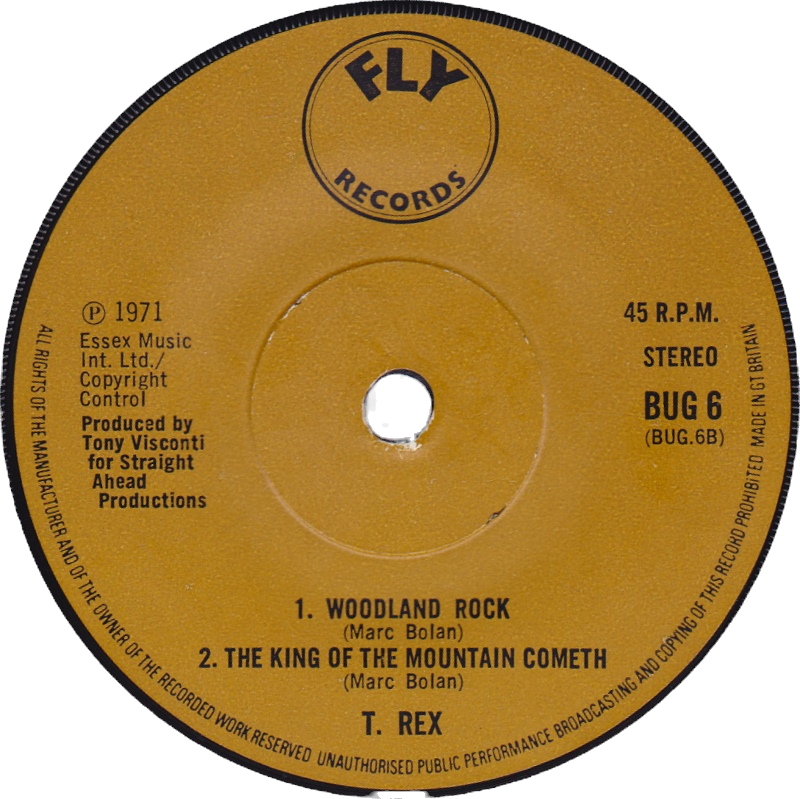
UK Fly Records mustard‑label 7-inch for “Woodland Rock,” and "The King of the Mountain Cometh" showing catalogue number BUG 6 and production credit for Tony Visconti.
Caption:
T. Rex’s “Hot Love” (1971), issued on Fly Records as BUG 6 — first pressing with mustard labels.
🔘 – Related Material
• “Ride a White Swan” (1970)
• Electric Warrior (1971)
• “Get It On” (1971)
• “Jeepster” (1971)
Explore the tags below for connected posts and themes.
🔘 – Discography
Ride a White Swan — 1970
Hot Love — 1971
Get It On — 1971
Jeepster — 1971
🔘 – Mini‑Timeline
✦ February 19, 1971 — Single released
✦ February 27, 1971 — Enters UK chart
✦ March 20, 1971 — Reaches No. 1
✦ April 1971 — Six consecutive weeks at No. 1
✦ June 19, 1971 — Final chart week
🔘 – Glam Flashback
“Hot Love” is the moment glam rock truly ignited. Bolan’s shimmering performance, the swaggering groove, and the effortless charm of the track transformed T. Rex from cult favourites into national icons — and set the stage for the glitter‑soaked decade to come.
🔘 – Closing Notes
A landmark single in British pop history, “Hot Love” remains one of Marc Bolan’s most influential recordings — the spark that lit the glam‑rock fuse and propelled T. Rex into the mainstream.
🔘 – Sources
Discogs
Official Charts Company
Fly Records
Wikipedia
🔘 – Copyright
All original text and images remain the copyright of their respective publishers and creators.
Presented for historical, educational, and archival purposes.


Comments