top of page

David Bowie: "Space Oddity" Single (1969)

  • Writer: David Bowie
    David Bowie
  • Jul 10, 1969
  • 4 min read

Updated: Sep 22, 2025

David Bowie’s "Space Oddity" backed with "Wild Eyed Boy From Freecloud", was released as a 7-inch vinyl single in the UK by Philips Records (catalog number BF 1801) on July 11, 1969.

Label: Philips    Country: UK                             Catalogue:	BF 1801 / 304 201 BF
Label: Philips Country: UK Catalogue: BF 1801 / 304 201 BF

Overview:

Label: Philips (UK), Mercury (US)

Producer: Gus Dudgeon ("Space Oddity"), Tony Visconti ("Wild Eyed Boy From Freecloud")

Context: Released to coincide with the Apollo 11 moon landing (July 20, 1969), the single marked a pivotal moment in David Bowie’s career, establishing him as a visionary artist.


"Space Oddity" (A-side):Genre: Folk rock, psychedelic, space rock

Length: 5:15 (album version); 4:33 (single edit)


Inspiration: Inspired by Stanley Kubrick’s 2001: A Space Odyssey (1968), the song tells the story of Major Tom, an astronaut who becomes detached from his spacecraft and drifts into space, symbolizing alienation and existential drift.


Musical Elements: Features a haunting melody with acoustic guitar, strings, and the innovative use of the Stylophone, a pocket-sized electronic instrument.

Lyrically, it blends sci-fi imagery with themes of isolation and loss of control ("Ground Control to Major Tom").


Impact: Initially a modest hit, reaching #5 in the UK Singles Chart in 1969.

Became Bowie’s breakthrough, especially after its 1973 re-release in the US, where it reached #15 on the Billboard Hot 100.

Reused in later works, notably in Bowie’s 1980 sequel "Ashes to Ashes."

Widely regarded as one of Bowie’s signature songs, covered by artists like Chris Hadfield (recorded aboard the International Space Station in 2013).


Cultural Significance: The BBC used the song during its coverage of the Apollo 11 moon landing, cementing its association with space exploration.

Its themes of alienation resonated with the counterculture of the late 1960s.

Label: Philips    Country: UK                             Catalogue:	BF 1801 / 304 201 BF
Label: Philips Country: UK Catalogue: BF 1801 / 304 201 BF

"Wild Eyed Boy From Freecloud" (B-side):Genre: Folk rock, psychedelic

Length: 4:50

Inspiration: A poetic, narrative-driven song about a mystical boy facing persecution from a village, interpreted as a metaphor for individuality versus conformity.


Musical Elements: Features lush orchestration, including strings and brass, arranged by Tony Visconti.

Showcases Bowie’s early storytelling style, with vivid, almost theatrical imagery.


Impact: Less commercially prominent than "Space Oddity" but critically appreciated for its ambition.

Appeared on Bowie’s 1969 album David Bowie (also known as Space Oddity in some markets).

A fan favorite among early Bowie enthusiasts for its lyrical depth.


Reception and Legacy: The single was a bold step for Bowie, transitioning from his earlier, more conventional pop efforts to a distinctive, theatrical style.

"Space Oddity" became iconic, influencing the space rock genre and inspiring countless artists.

The single’s release aligned perfectly with the cultural fascination with space travel, making it a zeitgeist-defining moment.

Both tracks were included on the 1969 album David Bowie (reissued as Space Oddity), which laid the groundwork for Bowie’s chameleon-like career.

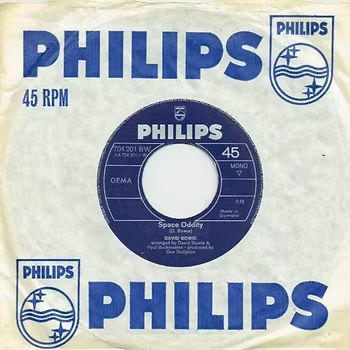
Label: Philips Country: Belgium            Catalogue:	704 201 BW
Label: Philips Country: Belgium Catalogue: 704 201 BW

Chart Performance: UK: Peaked at #5 (1969), later #1 upon re-release in 1975.

US: Reached #15 in 1973 (Mercury re-release).

Certified Gold in the UK (2016) for over 400,000 sales.


Session Musicians: The release featured a talented group of session musicians, with Herbie Flowers playing a pivotal role as the bassist.


Contribution: "Space Oddity": Flowers provided the distinctive, melodic bassline that anchors the song’s atmospheric and melancholic tone. His playing complements the song’s dynamic shifts, from the acoustic verses to the soaring, orchestral choruses.


"Wild Eyed Boy From Freecloud": His bass work supports the song’s lush, cinematic arrangement, adding depth to the narrative-driven track.

Label: Philips Country: Norway            Catalogue:	BF 304 201
Label: Philips Country: Norway Catalogue: BF 304 201

Other Session Musicians: The ensemble was a mix of skilled session players and emerging talents, assembled by producer Gus Dudgeon (for "Space Oddity") and Tony Visconti (for "Wild Eyed Boy From Freecloud").


Key musicians included: Rick Wakeman (Mellotron, Keyboards):Then an up-and-coming session player (later of Yes fame), Wakeman played the Mellotron, contributing to the ethereal, spacey sound of "Space Oddity."

His keyboard work added a haunting, futuristic texture, particularly in the song’s instrumental sections.


Mick Wayne (Guitar):Guitarist for the band Junior’s Eyes, Wayne provided the electric guitar parts for "Space Oddity."

His playing added subtle rock flourishes, complementing Bowie’s acoustic guitar.


Terry Cox (Drums):A member of the folk-jazz group Pentangle, Cox provided understated yet precise drumming, giving "Space Oddity" its rhythmic backbone.


Paul Buckmaster (String Arrangements):Arranged the lush string sections for both tracks, particularly prominent in "Wild Eyed Boy From Freecloud."

His orchestral work added a cinematic quality, enhancing the songs’ emotional depth.

David Bowie (Vocals, Acoustic Guitar, Stylophone): Bowie himself played acoustic guitar and the Stylophone (a small electronic instrument) on "Space Oddity," contributing to its distinctive sound.


Notable Facts :Recorded at Trident Studios, London, in June 1969.

The song’s production was rushed to capitalize on the Apollo 11 mission, with Bowie reportedly writing it in a matter of days.

"Space Oddity" was Bowie’s first major hit, but he struggled to replicate its success until Ziggy Stardust in 1972.

The single’s cover art featured a simple portrait of Bowie, reflecting his folk-singer persona at the time.

Comments


bottom of page