David Bowie (May 1983) The Face - Cover Feature
- David Bowie

- May 1, 1983
- 5 min read
Updated: May 6
Publication: The Face Magazine
Date: May 1983
Country: United Kingdom
Format: Cover Feature / Photo Portrait
What the Clipping Shows
A Tony McGee portrait of Bowie in a grey check suit, white shirt, and turquoise‑striped tie. The masthead THE FACE runs vertically down the left, with the headline “COOL, CALM + COLLECTABLE” and bold yellow type announcing DAVID BOWIE.
The Story Behind It
This cover marked The Face’s third anniversary — a statement of style and cultural authority.
“Three years of The Face: fashion, form + style.”
It presents Bowie as the ultimate modern icon — confident, immaculate, and perfectly aligned with early‑’80s sophistication.


📰 Page 1 — The Face Interview Begins
Publication: The Face Magazine
Date: May 1983
Country: United Kingdom
Section / Page: pp. 14–15
Format: Interview / Feature Introduction
What the Clipping Shows
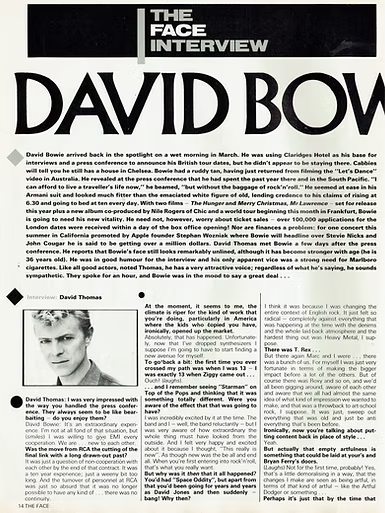
Headline: THE FACE INTERVIEW – DAVID BOWIE.
The opening spread introduces Bowie’s interview with bold typography and a clean, modern layout. A small black‑and‑white portrait of Bowie appears in the lower left corner beside the text columns. The article begins with Bowie’s return to the spotlight, describing his press conference at Claridge’s Hotel and his renewed energy following the filming of the Let’s Dance video in Australia.
The Story Behind It
This page sets the tone for the entire feature — Bowie as a revitalised, confident artist entering his most commercially successful era.
“He seemed at ease in his Armani suit and looked much fitter than the emaciated white figure of old.”
The writing captures the excitement of Bowie’s transformation: from avant‑garde experimenter to global pop icon.
“With two films – The Hunger and Merry Christmas, Mr Lawrence – set for release this year plus a new album co‑produced by Nile Rodgers, Bowie is going to need his new vitality.”
It’s a portrait of discipline and reinvention — Bowie embracing mainstream success while maintaining his artistic edge.
📰 Page 2 — Fragmented Identity
Publication: The Face Magazine
Date: May 1983
Country: United Kingdom
Section / Page: pp. 18–19
Format: Interview / Photo Feature
What the Clipping Shows
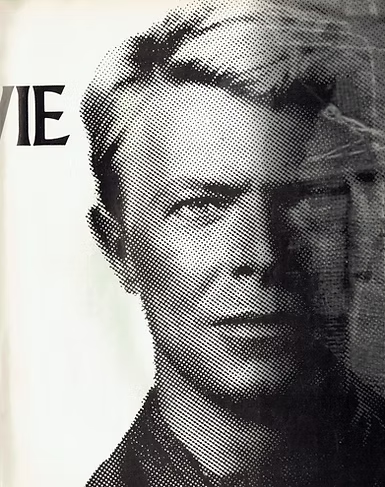
A full‑page halftone portrait of Bowie dominates the layout — stark, graphic, and minimalist. The cropped text “VIE” hints at his name, reinforcing the visual focus on identity and fame. The design uses bold contrast and dot‑screen texture to turn Bowie’s face into an art object, bridging photography and print design.

The Story Behind It
This page acts as a visual pause in the interview — a moment of reflection between dialogue sections.
“I was completely fractured as a thinker.”
The halftone treatment mirrors Bowie’s introspection and self‑analysis throughout the feature. It’s The Face at its most avant‑garde: transforming celebrity portraiture into graphic art.
The image captures Bowie’s duality — the man and the myth — frozen mid‑transition between underground innovator and global icon.

📰 Page 3 — Art and Alienation
Publication: The Face Magazine
Date: May 1983
Country: United Kingdom
Section / Page: pp. 20–21
Format: Interview / Cultural Reflection
What the Clipping Shows
A two‑column continuation of the interview, headed vertically with “DAVID BOWIE.”
A monochrome portrait of Bowie appears at the top left, followed by dense text in Q&A format. The discussion moves into Bowie’s reflections on creativity, therapy, and the surreal disconnection of his mid‑’70s years.
The Story Behind It
This section captures Bowie’s self‑analysis and philosophical tone.
“I think it’s the first album I’ve made in years that I’ve really enjoyed making.”
He speaks about artistic renewal, emotional clarity, and the discipline that defines his Let’s Dance era.
“Everything about that period was totally surreal for me.”
The layout and typography reinforce The Face’s modernist aesthetic — clean, structured, and introspective.
📰 Page 4 — Personal and Philosophical
Publication: The Face Magazine
Date: May 1983
Country: United Kingdom
Section / Page: pp. 22–23
Format: Interview / Portrait Feature
What the Clipping Shows
Two monochrome portraits of Bowie — one small at the top, one larger near the bottom — frame the continuation of the interview. The vertical sidebar again reads “DAVID BOWIE.” The text explores Bowie’s thoughts on fame, friendship, and artistic maturity, with the interviewer’s questions in bold and Bowie’s answers in regular type.

The Story Behind It
This section deepens Bowie’s introspection. He discusses the balance between creativity and personal life, the value of genuine friendships, and the discipline that defines his later career.
“It’s one of the classically difficult things to do in rock music, to write something that is both musically and lyrically interesting.”
He reflects on his evolution from restless innovator to focused craftsman, revealing a calm, philosophical tone that contrasts sharply with his earlier personas.
“Yes, I have a circle of friends that are, again, fairly artistically based.”
The layout’s clean design and dual portraits reinforce The Face’s minimalist aesthetic — Bowie as both thinker and icon.

📰 Page 5 — Legacy and Let’s Dance
Publication: The Face Magazine
Date: May 1983
Country: United Kingdom
Section / Page: pp. 24–25
Format: Interview / Closing Feature
What the Clipping Shows
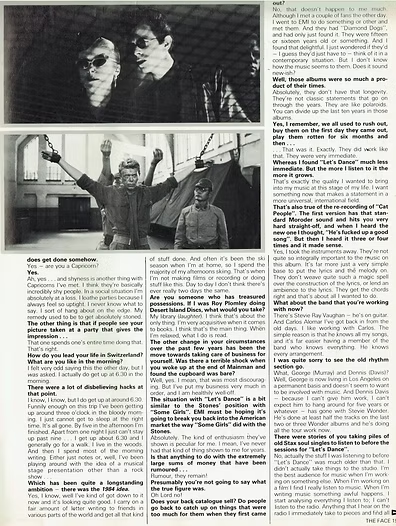
Two black‑and‑white photographs punctuate the final section — one showing Bowie with sunglasses beside another figure, and a second depicting him in an industrial setting with chains suspended overhead. The text continues in dense Q&A columns, covering Bowie’s daily life in Switzerland, his creative process, and the making of Let’s Dance.
The Story Behind It
This concluding section reveals Bowie’s grounded, reflective side. He discusses early mornings by Lake Geneva, reading, skiing, and fishing — a portrait of calm after decades of chaos.
“I live in the woods. And I fish and boat. I live on the lake.”
He contrasts this serenity with the intensity of his recording sessions and the professionalism of his new band featuring Stevie Ray Vaughan and Carlos Alomar.
“I wanted something which makes a statement in a more universal, international field.”
The interview closes with Bowie’s thoughts on longevity and transformation — a man at peace with his evolution, yet still driven by curiosity and craft
📰 Page 6 — Closing Reflections and Philosophy
Publication: The Face Magazine
Date: May 1983
Country: United Kingdom
Section / Page: pp. 26–27
Format: Interview / Final Dialogue
What the Clipping Shows
The concluding portion of David Thomas’s interview with Bowie, headed vertically “DAVID BOWIE CONTINUES.”
A monochrome portrait sits at the top left, followed by dense text columns. The conversation moves through Bowie’s thoughts on professionalism, musical construction, stage performance, and his relationship with audiences. The page ends with Thomas’s reflective closing paragraph and a period advertisement for Robert Wyatt’s Shipbuilding single

The Story Behind It
This final section captures Bowie’s mature philosophy on art and communication.
“That’s the curse of professionalism. Once people get into the music business they hear the sound first, and the music second.”
He speaks candidly about resisting technical obsession, valuing emotional connection, and maintaining authenticity in performance.
“I want it to have much more of a relationship backwards and forwards.”
Bowie also discusses overcoming his fear of flying, rivalry with Mick Jagger, and the importance of honesty in interviews — rejecting the idea of saying what others want to hear.
The closing reflection by Thomas portrays Bowie as wiser, grounded, and self‑aware — a man who has survived fame’s distortions and emerged with clarity.
🧾 Sources
The Face Magazine, May 1983 — Interview by David Thomas, photography by Tony McGee and Dave Sims.
Original magazine scans from your archive collection.
© Copyright Notice
All original text excerpts, photographs, and magazine layouts remain the property of their respective copyright holders.
This scrapbook entry is presented for archival and educational purposes only.
No commercial use is intended.


Comments