


David Bowie (November 3, 2002) – “Starman At 55” Cover Feature - Sunday Express S:2
SUNDAY EXPRESS S:2 |
Published in the Sunday Express’s S:2 magazine,“Starman At 55” presents David Bowie at a markedly different stage of life from many of the characters represented in the archive photographs spread across the feature. The cover promises“David Bowie: On life through the eyes of a two-year-old – and why he’s still cool at 55,” while the three-page interview inside draws on a conversation with Gary Crowley ahead of VH1’s VH1 Reveals: David Bowie. Rather than relying entirely on retrospective nostalgia, the feature concentrates on Bowie’s life in 2002: family, fame, fatherhood, creativity, younger audiences and the way becoming a parent again had begun to influence the perspective behind the writing. The feature is illustrated with contemporary photography alongside images reaching back through several earlier Bowie identities. |
FEATURE HIGHLIGHTS
FEATURE | DETAILS |
Artist: |
|
Feature: |
|
Publication: | Sunday Express S:2 |
Interview: |
|
Date: | November 3, 2002 |
Related Programme: |
|
Format: | Cover + three-page feature |
Programme Broadcast: | November 4, 2002 |
Cover Photography: |
|
Age: | 55 |
Principal Theme: | Life, family and continuing creativity |
Current Era: |
|
ORIGINAL SOURCE MATERIAL
PAGE 1 | PAGE 2 |
 [IMAGE – SUNDAY EXPRESS S:2, NOVEMBER 3, 2002 – DAVID BOWIE / “STARMAN AT 55” – PAGE 1] | 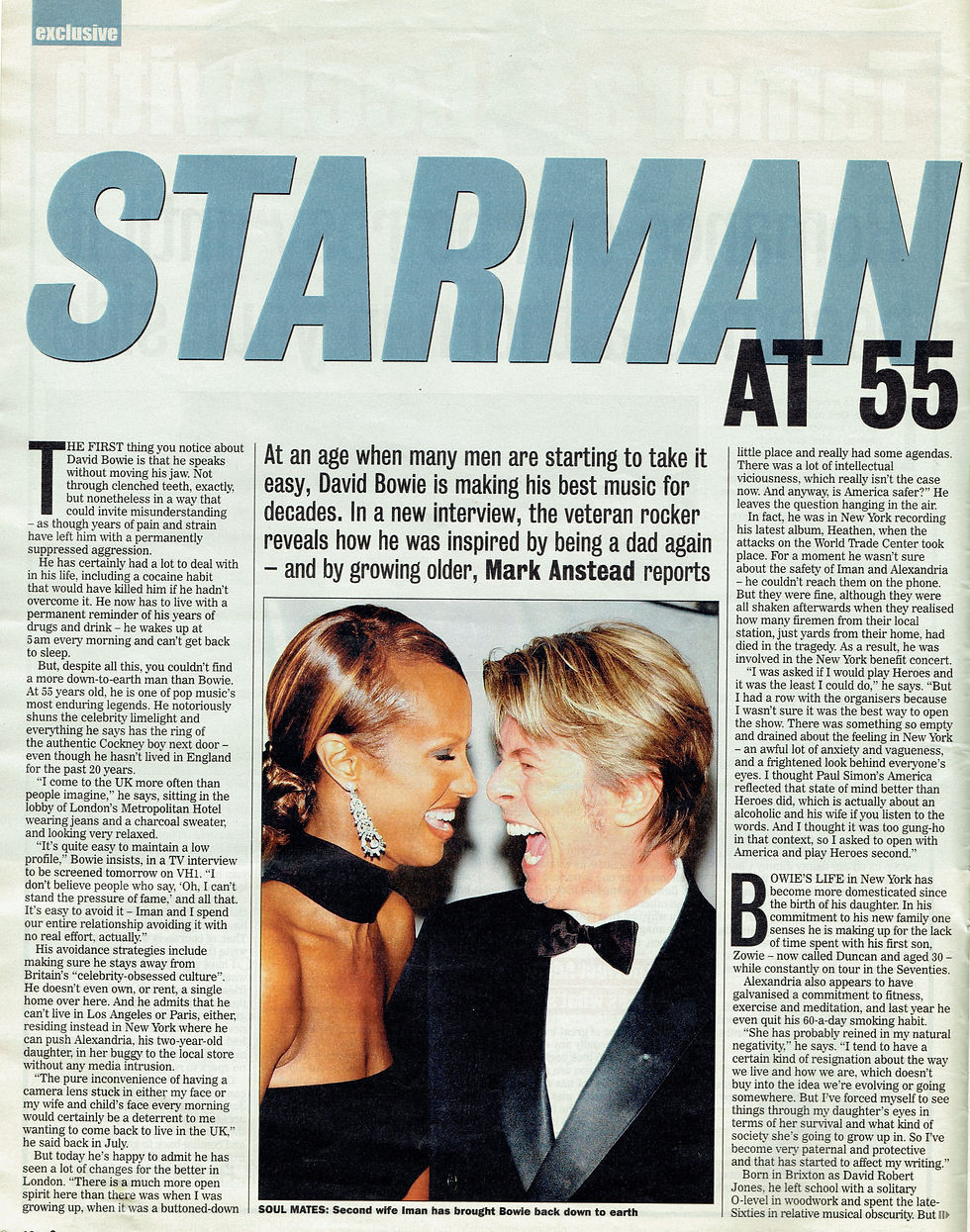 [IMAGE – SUNDAY EXPRESS S:2, NOVEMBER 3, 2002 – DAVID BOWIE / “STARMAN AT 55” – PAGE 2] |
PAGE 3 | PAGE 4 |
 [IMAGE – SUNDAY EXPRESS S:2, NOVEMBER 3, 2002 – DAVID BOWIE / “STARMAN AT 55” – PAGE 3] |  [IMAGE – SUNDAY EXPRESS S:2, NOVEMBER 3, 2002 – DAVID BOWIE / “STARMAN AT 55” – PAGE 4] |
INTRODUCTION
The central theme is change without disconnection from the past. At 55, Bowie discusses maintaining a private life despite decades of fame, the effect young daughter Alexandria had upon Bowie’s outlook, and the continuing presence of much younger listeners within the audience. The article also looks backwards through a career encompassing continually changing appearances and musical directions, something reinforced visually by the final page’s gallery of archive photographs. | Bowie argues that the recurring concerns in the songs, particularly isolation and alienation, were never tied exclusively to one generation. That provides the feature with its strongest thread: the person pictured across several decades may change dramatically, but many of the subjects driving the work remain recognisable. |
THE COVER
VISUAL PRESENTATION | EDITORIAL PRESENTATION |
Large colour portrait against a vivid green background. | DAVID BOWIE dominates the lower portion in large white lettering. |
The subject wears a green jacket over a light shirt. | Cover line:“On life through the eyes of a two-year-old – and why he’s still cool at 55.” |
The portrait fills almost the entire page. | The Bowie story is clearly the principal feature of the supplement. |
Smaller secondary stories run vertically down the left. | S:2 branding and issue details occupy the upper-left corner. |
The green-on-green composition creates an unusually unified cover. The clothing and background almost merge, allowing the face and enormous white DAVID BOWIE typography to provide the strongest contrast. | The cover photograph was credited by the official Bowie website to Frank Ockenfels, while the accompanying Bowie announcement specifically described the inside article as a three-page feature headed“Starman at 55.” |
STARMAN AT 55
BOWIE THEN | BOWIE AT 55 |
Numerous identities and visual transformations. | Discussing family life and fatherhood. |
Fame stretching across several decades. | Maintaining a relatively private personal life. |
Constant stylistic movement. | Continuing to write and record new material. |
Audience developed across successive eras. | Younger listeners discovering earlier and contemporary work. |
Recurring themes of isolation and alienation. | Bowie argues those subjects remain relevant without being generational. |
The headline“STARMAN AT 55” deliberately invokes one of Bowie’s most enduring early songs while locating the article firmly in the present. | The feature is therefore retrospective without becoming purely nostalgic. Earlier versions of Bowie provide context, but the central subject is how the artist was thinking and living in 2002. |
FAME & PRIVACY
Bowie discusses the assumption that celebrity automatically makes ordinary privacy impossible. | Bowie tells the interviewer that visits to Britain occurred more frequently than many people imagined and argues that maintaining a low profile was not especially difficult. |
PUBLIC LIFE | PRIVATE LIFE |
Decades of international recognition | Low profile deliberately maintained |
Continuing press interest | Visits to Britain without constant attention |
Highly recognisable public history | Family life kept comparatively private |
Celebrity status | Bowie rejects the idea that fame inevitably makes privacy impossible |
Bowie describes a shared approach with Iman in which the relationship is kept away from unnecessary publicity rather than accepting constant exposure as an unavoidable consequence of fame. |
FATHERHOOD
The cover’s reference to seeing life through the eyes of a two-year-old points directly towards one of the interview’s most personal subjects. | Bowie explains that Alexandria had altered aspects of the way Bowie considered the future. |
BEFORE | CHANGING PERSPECTIVE |
Bowie describes a natural tendency towards negativity. | Fatherhood encourages a more protective outlook. |
Scepticism about human progress. | Greater consideration of the world a child will inherit. |
Personal outlook informs creativity. | New perspective begins influencing songwriting. |
Long-established habits and routines. | Renewed attention to fitness, exercise and meditation. |
The official Bowie preview describes Alexandria as having encouraged a commitment to fitness, exercise and meditation and notes that Bowie had also stopped a long-standing smoking habit the previous year. | More importantly for the work itself, Bowie says that becoming increasingly paternal and protective had begun affecting the writing. |
SEEING THE WORLD DIFFERENTLY
PERSONAL CHANGE | CREATIVE EFFECT |
Parenthood changes perspective on the future. | Writing begins reflecting more protective concerns. |
Bowie considers the society Alexandria will inherit. | Familiar themes can be approached differently. |
Existing pessimism is challenged. | New personal circumstances affect creative thought. |
Focus extends beyond the self. | Survival and the future acquire greater importance. |
This is arguably the most revealing part of the article because the family discussion is directly connected to Bowie’s creative process. | The interview does not suggest that fatherhood had removed Bowie’s longstanding scepticism. Instead, Bowie describes being compelled to look at the future through another person’s prospects rather than purely through the established personal worldview. |
A YOUNGER AUDIENCE
The feature also addresses the unusual breadth of Bowie’s audience. | Bowie notes that many younger bands continued citing the work as an influence and directing listeners towards earlier recordings. |
LONG CAREER | NEW LISTENERS |
Recordings stretching back decades. | Younger musicians cite Bowie as an influence. |
Established older audience. | Internet audience includes many younger fans. |
Earlier work remains available. | New listeners investigate the catalogue. |
Contemporary Bowie continues recording. | Different generations encounter the work from different starting points. |
Bowie cites the online audience as evidence that younger listeners were actively engaging with the work. | Although the magazine apparently rendered the website name incorrectly, the official Bowie commentary makes clear that Bowie was referring to BowieNet. |
NOT WRITING FOR AN AGE GROUP
Bowie rejects the idea of deliberately writing material for contemporary teenagers. | Instead, Bowie argues that the work had never been particularly generational. |
NOT THE APPROACH | BOWIE’S APPROACH |
Writing specifically for an 18-year-old audience | Writing about subjects that remain personally important |
Chasing youth culture | Allowing younger listeners to discover the work naturally |
Replacing older themes to appear contemporary | Returning to recurring concerns |
Treating every generation as requiring different subject matter | Isolation and alienation remain central |
The recurring themes Bowie identifies include isolation and forms of alienation, subjects considered broad enough to remain meaningful regardless of the listener’s age. | That explanation provides a persuasive reason for the feature’s cover claim about Bowie remaining “cool at 55”: relevance is presented less as the result of attempting to appear young than as the consequence of continuing to explore subjects that do not belong exclusively to one generation. |
HEATHEN
CONTEMPORARY BOWIE | CAREER CONTINUITY |
Heathen represents the current recording period. | Earlier Bowie remains visible throughout the feature. |
New work continues in 2002. | Past identities are used as points of comparison. |
Contemporary interviews focus on present concerns. | Familiar creative themes continue resurfacing. |
Bowie is 55. | Age is presented as another stage rather than an endpoint. |
The official Bowie website also noted an error in the magazine’s treatment of Heathen: although the album had been nominated for the 2002 Mercury Music Prize, it had not won the award. | That correction is worth retaining in the archive rather than perpetuating the mistake from the original feature. |
THE ARCHIVE PHOTOGRAPHS
EARLIER IMAGES | CONTEMPORARY CONTEXT |
Multiple earlier Bowie appearances are reproduced. | The feature contrasts those images with Bowie at 55. |
Different hairstyles, costumes and performance settings appear. | The visual sequence reinforces continual reinvention. |
Formal-event and stage photography are included. | Earlier identities become part of a long career rather than isolated eras. |
A full-page monochrome portrait provides a dramatic visual break. | The modern interview supplies the narrative connecting the images. |
The final feature page uses a collage of photographs from different points in Bowie’s career. Visually, this makes the article’s argument before the reader even reaches the text: the appearance repeatedly changes while the career continues. | The full-page monochrome portrait between the text-heavy pages gives the feature an unusually strong visual rhythm, turning the three-page article into something closer to a mini portfolio. |
THE COVER & FEATURE DESIGN
COVER | INSIDE FEATURE |
Bright green colour treatment | Large blue STARMAN headline |
Contemporary portrait | Combination of current and archive photographs |
Huge white Bowie lettering | Multi-column newspaper-style text |
Primary focus on Bowie | Full-page monochrome portrait |
“Still cool at 55” framing | Retrospective photographic collage |
The design deliberately balances Bowie now against Bowie then. | Rather than selecting one famous historical image for nostalgia, the feature uses multiple periods to demonstrate the extent of Bowie’s visual transformations. |
JOHN LENNON & MEMORY
The final page contains a large pull quote referring to John Lennon, placing memories of earlier periods alongside the contemporary discussion. The archive imagery around the quotation reinforces the retrospective element of the closing page, allowing the feature to move between Bowie’s personal memories and the succession of identities visible across the photographs. | The article consequently becomes less about celebrating a milestone birthday than considering what remains after several decades of continuous artistic change. |
VH1 REVEALS: DAVID BOWIE
S:2 FEATURE | VH1 PROGRAMME |
Published as a preview | Full interview programme |
Starman At 55 | VH1 Reveals: David Bowie |
Conversation with Gary Crowley | Broadcast on VH1 |
Sunday Express supplement | Scheduled for November 4, 2002 |
Selected interview material | Wider televised conversation |
The official Bowie website explicitly described the S:2 article as a preview of Gary Crowley’s interview for VH1 Reveals: David Bowie, scheduled for 8.00 pm on VH1 the following evening. | That makes the magazine feature part of a wider contemporary Bowie media appearance rather than a standalone retrospective. |
CONTEXT AND NOTES
PERSONAL CONTEXT | ARCHIVAL SIGNIFICANCE |
Bowie at 55 | Contemporary snapshot of Bowie in 2002 |
Young daughter influencing outlook | Documents discussion of fatherhood and creativity |
Family privacy emphasised | Contrasts private life with international fame |
Younger fans discovering Bowie | Records Bowie’s views on a multi-generational audience |
Heathen period | Connects current work with the wider career |
Interview tied to VH1 programme | Preserves print preview of the television interview |
What makes“Starman At 55” particularly valuable is that it resists presenting Bowie solely as a heritage artist. The archive photography inevitably encourages comparison with Ziggy-era and other earlier identities, but Bowie’s own comments consistently turn the discussion back towards contemporary life, family and writing. | The feature therefore captures a moment when Bowie was balancing an enormous established history with a very active present. Younger musicians and listeners were discovering different points in the catalogue, while Bowie’s own attention was increasingly shaped by fatherhood and the future Alexandria would inhabit. |
AT A GLANCE
FEATURE | DETAILS |
Cover Artist: | David Bowie |
Feature: | Starman At 55 |
Publication: | Sunday Express S:2 |
Date: | November 3, 2002 |
Interview: | Gary Crowley |
Cover Photography: | Frank Ockenfels |
Related Programme: | VH1 Reveals: David Bowie |
Current Album: | Heathen |
Principal Themes: | Fatherhood, privacy, creativity and younger audiences |
WHAT THE FEATURE SHOWS
BOWIE AT 55 | CAREER IN RETROSPECT |
Contemporary cover portrait | Multiple archive photographs |
Discussion of fatherhood | Continual changes in appearance |
Maintaining privacy | Decades of public fame |
Changed perspective through Alexandria | Earlier Bowie identities |
Younger BowieNet audience discussed | Influence upon younger musicians |
Heathen-period creativity | Recurring themes of isolation and alienation |
Looking towards a child’s future | Long career presented as continuing evolution |
The strongest message running through the package is not simply that Bowie remained famous at 55. It is that Bowie had reached a point where the past could be acknowledged without becoming trapped by it. | The archive pictures demonstrate just how many versions of Bowie had already existed, while the interview shows attention remaining firmly on present life and future concerns. |
SOURCES / COPYRIGHT & ARCHIVAL USE |
SOURCES David Bowie official website – VH1 Interview Previewed In S:2 Magazine COPYRIGHT & ARCHIVAL USE All magazine scans, photographs, and original text excerpts referenced in this entry remain the property of their respective copyright holders. This Chronicle entry is a transformative, non-commercial archival summary created for historical documentation and educational reference. No ownership of the original material is claimed or implied. |


Comments