


David Bowie (September 16, 1978) – “The NME Consumer’s Guide to David Bowie – Part Three: All the Young Dudes” – New Musical Express
Updated: 2 days ago
DAVID BOWIE |
This New Musical Express feature from September 16 1978 continues the magazine’s in‑depth retrospective series on David Bowie’s career. Subtitled “All the Young Dudes,” it catalogues the songs Bowie wrote and produced for other artists, offering readers a detailed look at his creative reach beyond his own recordings. |
INTRODUCTION Written by Charles Shaar Murray and Roy Carr, the article serves as a comprehensive guide to Bowie’s collaborations and production work. It lists and discusses tracks he created for performers such as Mott the Hoople, Lou Reed, and Iggy Pop, tracing how his songwriting and studio influence shaped the sound of the 1970s. | The layout features Bowie photographed on public transport holding a small dog, alongside smaller portraits of associated artists. The tone is analytical yet celebratory, positioning Bowie as a multifaceted figure whose artistry extended far beyond his own albums. |
FEATURE HIGHLIGHTS
FEATURE | DETAILS |
Publication: | New Musical Express |
Date: | September 16 1978 |
Country: | United Kingdom |
Event: | Part Three of NME’s David Bowie career retrospective |
Era: | 1978 – Post‑Berlin Period / Retrospective Analysis |
Tone: | Informative and reverent |
Photography: | Black‑and‑white images of David Bowie and artists he collaborated with |
ORIGINAL SOURCE MATERIAL
PAGE 1 | PAGE 2 |
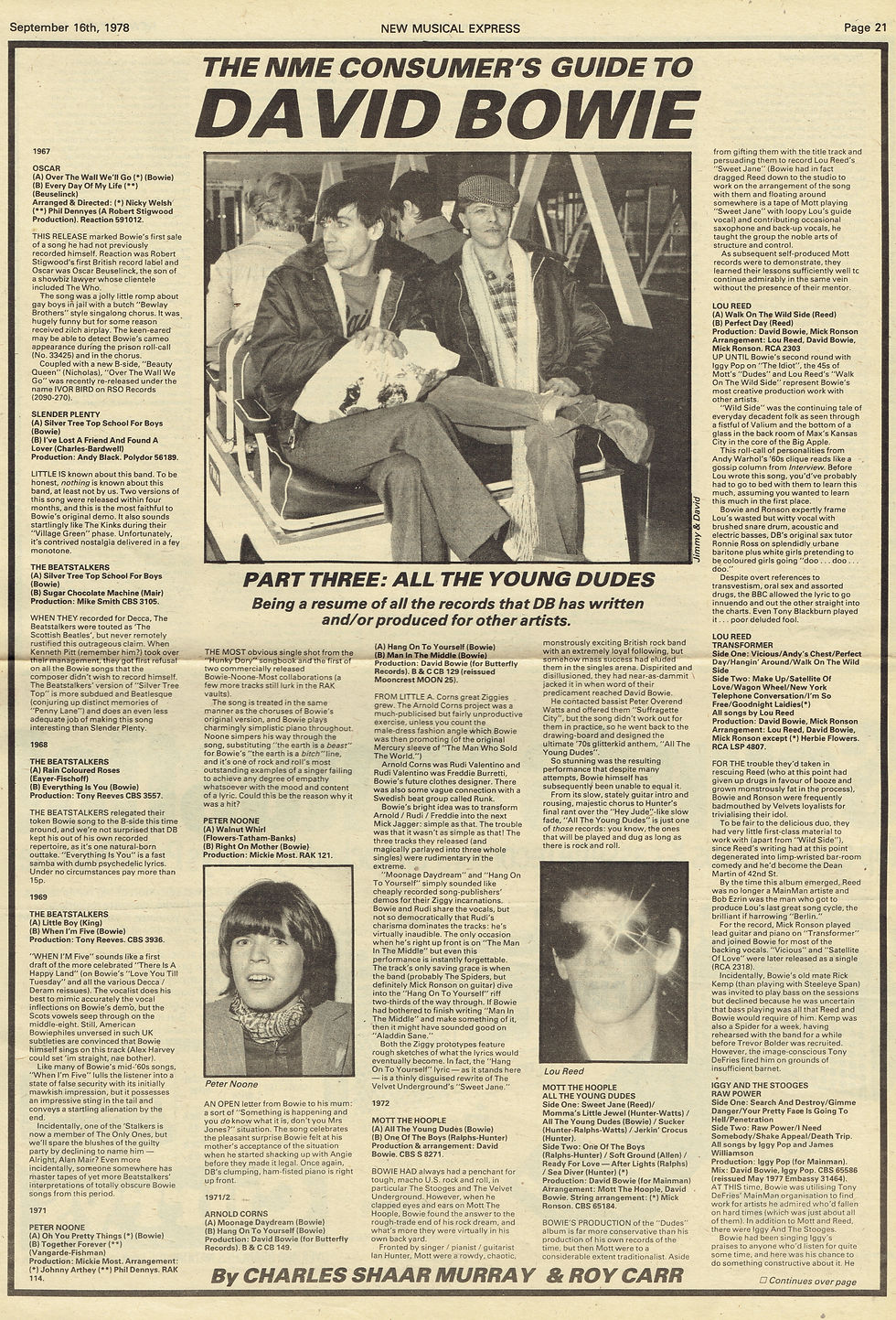 [DAVID BOWIE – SEPTEMBER 16, 1978] |  [DAVID BOWIE – SEPTEMBER 16, 1978] |
THE STORY & CONTEXT
CONTEXT AND NOTES | CONTEXT AND NOTES |
By 1978, Bowie was touring Stage and reflecting on a decade of innovation that had redefined pop and rock. This NME series—published in multiple parts—acted as both a fan guide and a critical archive, documenting his evolution from glam‑rock pioneer to avant‑garde producer. | The “All the Young Dudes” installment highlights his mentorship of other musicians and his role in shaping the era’s soundscape. |
COPYRIGHT & ARCHIVAL USE |
All magazine scans, photographs, and original text excerpts referenced in this entry remain the property of their respective copyright holders. This Chronicle entry is a transformative, non‑commercial archival summary created for historical documentation and educational reference. No ownership of the original material is claimed or implied. |


Comments