


Iggy Pop (May 12, 1977) Circus Magazine – Album Review
Updated: 2 days ago
IGGY POP |
Iggy Pop (May 12, 1977) Circus Magazine – Album Review |
FEATURE HIGHLIGHTS
FEATURE | DETAILS |
Publication: | Circus Magazine |
Date: | May 12, 1977 |
Country: | United States |
Section / Pages: | Album Review Column |
Title: | The Idiot — Iggy Pop (RCA Victor) |
Writer: | Wesley Strick |
Event: | Review of Iggy Pop’s album The Idiot |
Era: | 1977 – Berlin period / Post-Stooges era |
Tone: | Analytical, dark and macabre |
Photography: | Text-only column layout |
Audience: | Circus readers and serious rock fans |
ORIGINAL SOURCE MATERIAL
PAGE 1 | PAGE 2 |
 [IGGY POP – MAY 12, 1977] | 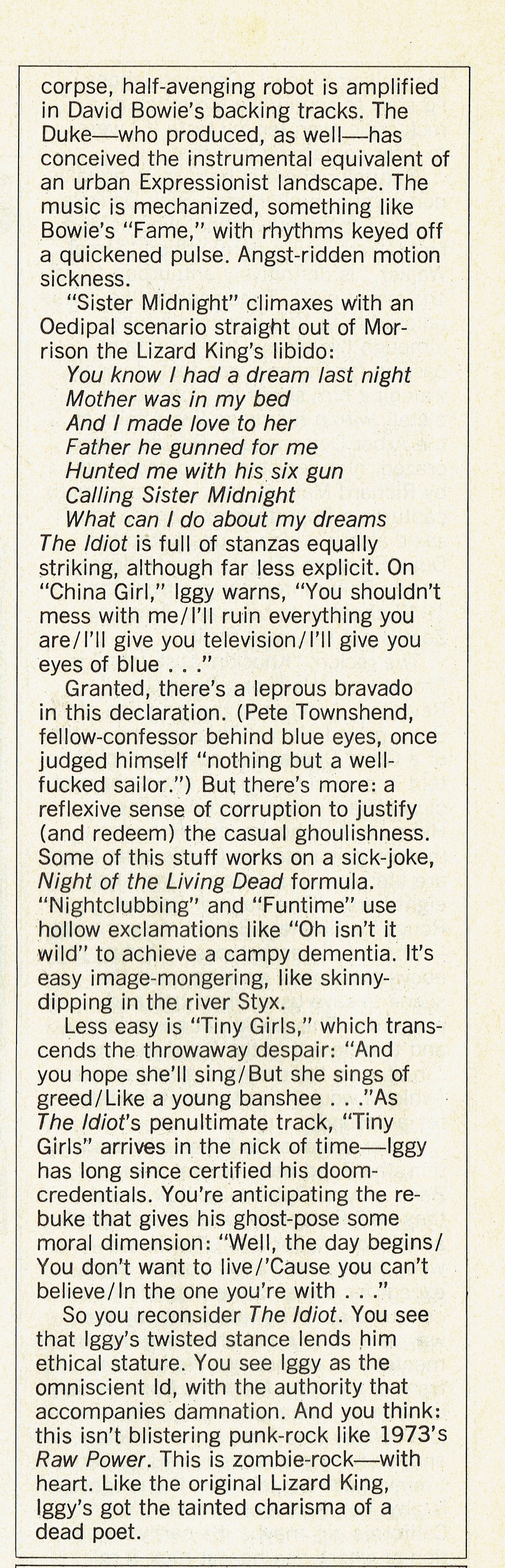 [IGGY POP – MAY 12, 1977] |
THE STORY & CONTEXT
THE STORY | CONTEXT AND NOTES |
In this review, Wesley Strick reflects on Iggy Pop’s collaboration with David Bowie on The Idiot, noting its eerie, mechanised quality and comparing it to what a late-period Jim Morrison album might have sounded like. He highlights the death-rattle vocals on “Sister Midnight”, the detached delivery of lines like “We learn dances, brand new dances / Like the nuclear bomb,” and draws parallels to Lou Reed’s Berlin and Bobby Pickett’s “Monster Mash.” | Released in March 1977, The Idiot marked Iggy Pop’s artistic rebirth after the Stooges era. Recorded in Berlin with David Bowie, the album’s cold, industrial sound represented a stark departure from raw garage rock toward a more controlled, avant-garde aesthetic that would heavily influence post-punk and industrial music |
WHAT THE CLIPPING SHOWS
A single-column review with the bold header “The Idiot—Iggy Pop (RCA Victor)” by Wesley Strick. The text explores the album’s haunting atmosphere, Iggy’s transformed vocal style, and its place in the evolving rock landscape of the mid-1970s.
COPYRIGHT & ARCHIVAL USE |
All magazine scans, photographs, and original text excerpts remain the property of their respective copyright holders. This Chronicle entry is a transformative, non‑commercial archival summary created for historical documentation and educational reference. No ownership of the original material is claimed or implied. |

Comments