


David Bowie (October 26, 1974) – “Bowie: Bare And Hoarse” David Live Album Review - Melody Maker
This Melody Maker review gives an exclusive preview of David Bowie’s forthcoming double album David Live, recorded at the Tower Theater in Philadelphia. While recognising the strength of Bowie’s band and the ambitious packaging of the release, the reviewer is highly critical of Bowie’s strained vocals and argues that the recording fails to capture the theatrical power and excitement of the live shows themselves.
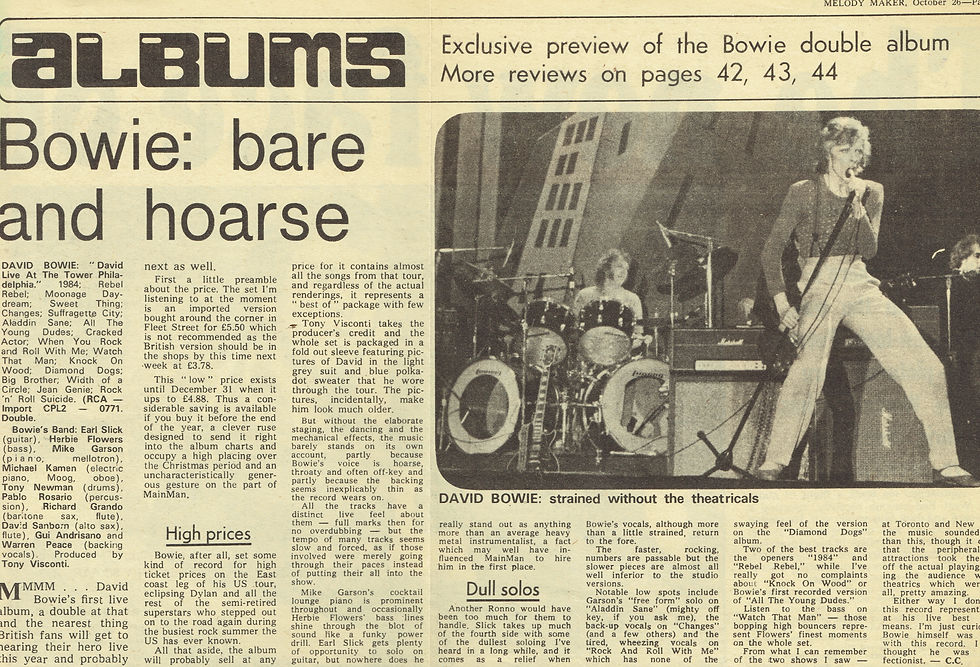
Publication: Melody Maker
Date: October 26, 1974
Country: United Kingdom
Published under the striking headline “Bowie: bare and hoarse”, the review examines the forthcoming double album David Live, recorded at the Tower Theater, Philadelphia, in 1974.
The article describes the album as containing material drawn from Bowie’s American concert performances and begins by considering both the music and the planned presentation of the record.
The reviewer notes that the album contains almost all the songs performed during the tour, with rearrangements of the actual running order. The release was expected to include elaborate packaging, with Tony Visconti responsible for the production.
The review also comments on the expected price of the double album, suggesting that its cost could be high because of the amount of material and packaging involved.
THE BAND
The accompanying review information provides detailed personnel for the live recording:
David Bowie – vocals
Earl Slick – guitar
Herbie Flowers – bass
Mike Garson – piano
Mellotron and electric piano
Pablo Rosario – percussion
Richard Grando – baritone saxophone and flute
David Sanborn – alto saxophone and flute
Gui Andrisano and Warren Peace – backing vocals
The reviewer is particularly complimentary about the musicians.
Herbie Flowers is singled out for praise, while Earl Slick’s guitar playing is also regarded favourably. Mike Garson receives particular attention for the prominent role of the piano within the arrangements.
BOWIE’S VOCALS
The central criticism of the album concerns Bowie’s voice.
The reviewer describes the vocals as strained, arguing that Bowie sometimes sounds painfully hoarse. This problem is considered especially noticeable because the live recording leaves the voice more exposed than some of Bowie’s studio productions.
The article suggests that Bowie’s heavy touring schedule may have contributed to the vocal difficulties captured on the recordings.
Despite the strength of the accompanying musicians, the reviewer repeatedly returns to the condition of Bowie’s voice as the album’s principal weakness.
THE ARRANGEMENTS
The review acknowledges that several songs have been substantially rearranged for the live performances.
Among the tracks specifically mentioned are:
“Here Today, Gone Tomorrow”
“Knock On Wood”
“Rock ’N’ Roll Suicide”
“Space Oddity”
“Rock ’N’ Roll With Me”
The article also discusses the live arrangement of “Diamond Dogs” and the way Bowie’s stage material had been adapted for the American performances.
The reviewer finds some of these reinterpretations effective while regarding others as less successful than the original recordings.
MISSING THE THEATRICS
One of the review’s main arguments is that David Live cannot reproduce the visual element that made Bowie’s concerts distinctive.
The photograph accompanying the article shows Bowie performing on stage with the band and is captioned:
“DAVID BOWIE: strained without the theatricals.”
The reviewer argues that the elaborate theatrical presentation of the concerts formed an important part of their impact. Once that visual component is removed, the music itself is left more exposed.
According to the article, this makes the limitations of the vocals considerably more noticeable.
CONTEXT AND NOTES
The page identifies the article as an “Exclusive preview of the Bowie double album”, giving readers an advance assessment of David Live.
The review is valuable because it captures an immediate contemporary reaction to Bowie’s decision to document the Diamond Dogs-era American stage show as a live record.
Rather than automatically praising the release, the writer provides a distinctly mixed assessment. The musicianship receives considerable approval, particularly the contributions of Mike Garson, Herbie Flowers and Earl Slick, while Bowie’s vocal performance and the absence of the concert’s visual spectacle receive strong criticism.
The result is an unusually candid contemporary assessment of David Live before the album had become part of Bowie’s established catalogue.
FEATURE HIGHLIGHTS
Event: Exclusive preview of David Live
Publication Date: October 26, 1974
Era: 1974 Diamond Dogs / David Live period
Tone: Mixed and strongly critical of Bowie’s vocals
Production: Tony Visconti
Photography: Large black-and-white live photograph showing Bowie performing on stage with the band
WHAT THE CLIPPING SHOWS
• Exclusive Melody Maker preview of the forthcoming double album David Live
• Recordings made at the Tower Theater in Philadelphia
• Tony Visconti credited with production
• Strong praise for Bowie’s accompanying musicians
• Particular attention given to Mike Garson, Herbie Flowers and Earl Slick
• Bowie’s vocals criticised as strained and hoarse
• Discussion of rearranged material from the live performances
• References to “Here Today, Gone Tomorrow,” “Knock On Wood,” “Rock ’N’ Roll Suicide,” “Space Oddity” and “Rock ’N’ Roll With Me”
• The reviewer arguing that the album loses an important dimension without Bowie’s theatrical stage presentation
All magazine scans, photographs, and original text excerpts referenced in this entry remain the property of their respective copyright holders. This Chronicle entry is a transformative, non-commercial archival summary created for historical documentation and educational reference. No ownership of the original material is claimed or implied.


Comments