


David Bowie / Iggy Pop (November 15, 1979) – “Bowie and Iggy” Readers’ Letters
Updated: 2 days ago
ROLLING STONE |
Two readers respond enthusiastically to Chris Hodenfield’s recent “Bad Boys in Berlin” feature on David Bowie and Iggy Pop. Buddy Martin calls the piece the most magical article encountered during years of reading Rolling Stone, while Deb Biggs praises the way Hodenfield juxtaposed Bowie’s changing moods, mentality and artistic medium with the atmosphere of Berlin. Together, the letters provide a compact contemporary record of how strongly the Bowie and Iggy feature affected some readers. |
FEATURE HIGHLIGHTS
FEATURE | DETAILS |
Principal Artists: | David Bowie / Iggy Pop |
Publication: | Rolling Stone |
Publication Date: | November 15, 1979 |
Section: | Readers’ Letters |
Heading: | Bowie and Iggy |
Earlier Feature Discussed: | Bad Boys in Berlin |
Writer of Earlier Feature: | Chris Hodenfield |
Rolling Stone Issue Referenced: | RS 301 |
Readers Published: | Buddy Martin / Deb Biggs |
Reader Locations: | Cambridge, Massachusetts / Bowling Green, Ohio |
Principal Location Discussed: | Berlin |
Format: | Readers’ Letters / Response to Earlier Feature |
Principal Theme: | Readers react to Rolling Stone’s portrayal of Bowie and Iggy Pop in Berlin |
ORIGINAL SOURCE MATERIAL
ORIGINAL ROLLING STONE LETTERS CUTTING |
 [IMAGE – ROLLING STONE, NOVEMBER 15, 1979 – “BOWIE AND IGGY” READERS’ LETTERS] |
INTRODUCTION
BOWIE AND IGGY | THE READERS RESPOND |
Rolling Stone’s November 15, 1979 letters section preserves two unusually enthusiastic responses to Chris Hodenfield’s earlier article on David Bowie and Iggy Pop. | Neither correspondent is discussing a new record or concert. The subject is the quality and atmosphere of the journalism itself, specifically Hodenfield’s “Bad Boys in Berlin”. |
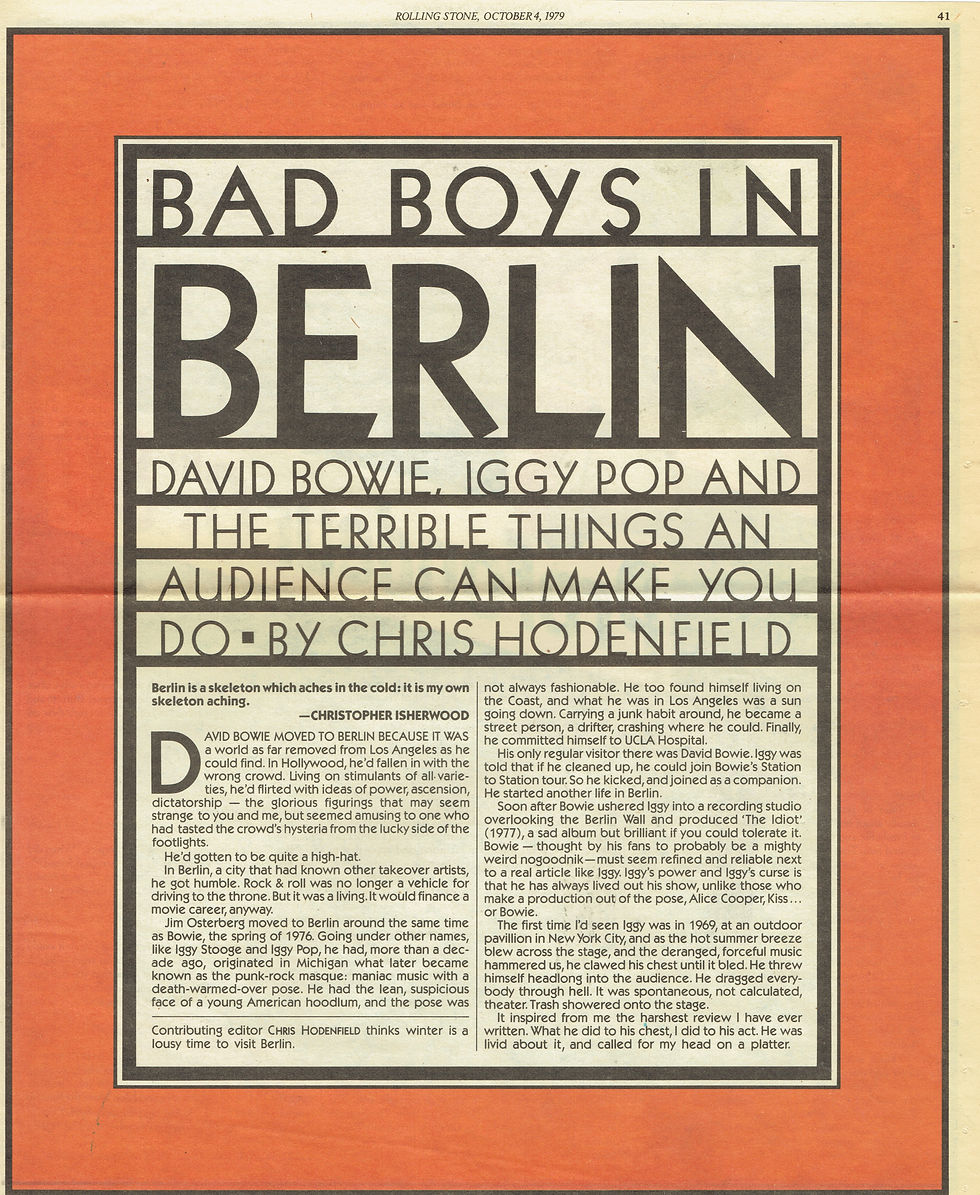
BAD BOYS IN BERLIN
CHRIS HODENFIELD | RS 301 |
Both letters concern Chris Hodenfield’s feature “Bad Boys in Berlin”. | Buddy Martin explicitly identifies the earlier piece as appearing in RS 301, providing a direct connection between the letters and the original Rolling Stone article. |
THE BERLIN SETTING
DAVID BOWIE | IGGY POP |
Berlin is central to the readers’ impressions of Hodenfield’s article. | The city is treated not merely as background but as something whose atmosphere interacts with the personalities and creative identities of Bowie and Iggy Pop. |
BUDDY MARTIN
CAMBRIDGE, MASSACHUSETTS | A LONG-TIME READER |
The first published letter comes from Buddy Martin of Cambridge, Massachusetts. | Martin begins by explaining that Rolling Stone had been regular reading since the publication’s San Francisco days. |
RALPH GLEASON
ROLLING STONE’S EARLIER YEARS | A READER’S POINT OF REFERENCE |
Martin specifically remembers the period when Ralph Gleason was writing for the publication. | The reference establishes the perspective of somebody comparing Hodenfield’s feature with a lengthy personal history of reading Rolling Stone. |
“THERE HAS NEVER APPEARED…”
EXCEPTIONAL PRAISE | BAD BOYS IN BERLIN |
Martin describes Hodenfield’s Bowie and Iggy article in exceptionally complimentary terms. | The correspondent regards it as the most magical article encountered during all those years of reading the magazine. |
A MAGICAL ARTICLE
NOT SIMPLY INFORMATIVE | ATMOSPHERE |
Martin’s reaction is based on more than the factual content of the Bowie and Iggy piece. | The word “magical” suggests that the writing and atmosphere made a particularly strong impression upon the reader. |
BOWIE AND IGGY POP
THE SUBJECTS | THE ARTICLE’S CENTRAL PAIR |
Bowie and Iggy Pop are jointly identified as the personalities who animate Hodenfield’s Berlin feature. | Martin’s letter treats the performers and their surroundings as inseparable elements of the article’s appeal. |
BERLIN MIST
THE CITY | A STRIKING IMAGE |
Martin invokes Berlin through an atmospheric image of the city’s mist. | The phrase reinforces the almost cinematic quality the correspondent attributes to Hodenfield’s writing. |
“ANGELS IN THE NIGHT”
BOWIE & IGGY | MARTIN’S DESCRIPTION |
Martin describes Bowie and Iggy shining through the Berlin atmosphere “like angels in the night”. | The image is the most poetic line in the first letter and demonstrates just how strongly the original feature affected the correspondent. |
DEB BIGGS
BOWLING GREEN, OHIO | THE SECOND LETTER |
The second published response comes from Deb Biggs of Bowling Green, Ohio. | Biggs is equally impressed by Hodenfield’s treatment of Bowie and Iggy Pop but concentrates more heavily on the construction of the article. |
“I CAN’T BEGIN TO TELL YOU…”
A STRONG RESPONSE | THE HODENFIELD PIECE |
Biggs opens by stressing the depth of the impression left by the article. | The enthusiasm immediately establishes that Rolling Stone had received more than one strongly favourable reader response to “Bad Boys in Berlin”. |
BOWIE’S MULTIFACETED NATURE
THE SECOND READER’S VIEW | A COMPLEX SUBJECT |
Biggs praises Hodenfield for revealing what the correspondent calls Bowie’s multifaceted nature. | The word acknowledges Bowie’s continual changes in presentation, approach and creative identity. |
“NEAR-BRILLIANT”
BIGGS ON BOWIE | THE READER’S WORDING |
Biggs describes Bowie’s nature as “near-brilliant”. | The qualification is interesting because the admiration is considerable without becoming completely uncritical hero worship. |
MOOD
ONE ELEMENT | JUXTAPOSITION |
Biggs specifically identifies mood as one of the elements Hodenfield juxtaposed. | The correspondent admires the way different dimensions of Bowie and Berlin were made to interact within the original article. |
MENTALITY
ANOTHER DIMENSION | CHARACTER & PLACE |
Mentality is the second element singled out in Biggs’s description. | Together with mood and medium, it becomes part of the reader’s explanation for why the article worked so effectively. |
MEDIUM
ARTISTIC EXPRESSION | A CHANGING BOWIE |
Biggs also mentions artistic medium. | The inclusion suggests that the appeal lay partly in Hodenfield capturing Bowie through several forms of expression rather than reducing the subject to one aspect of the career. |
THE CITY
BERLIN | BRIMMING WITH ALL THREE |
Biggs describes Berlin as seemingly overflowing with the same mixture of mood, mentality and medium. | The city therefore becomes an active counterpart to Bowie rather than merely somewhere the interview happened. |
“PERHAPS BOWIE HAS MET HIS MATCH IN BERLIN”
THE CLOSING THOUGHT | ARTIST & CITY |
Biggs concludes by suggesting that Bowie may have found a landscape sufficiently complicated to match Bowie’s own multifaceted nature. | It is an elegant contemporary expression of the association between Bowie and Berlin that would become increasingly important within later discussion of the period. |
TWO DIFFERENT RESPONSES
BUDDY MARTIN | DEB BIGGS |
Martin responds primarily to the atmosphere and emotional force of the article. | Biggs concentrates upon Hodenfield’s technique and the relationship between Bowie’s complexity and the character of Berlin. |
THE COMMON THREAD
HODENFIELD’S WRITING | BOWIE / IGGY / BERLIN |
Both readers praise the journalist rather than simply praising the artists. | Their letters demonstrate that the combination of subjects, writer and location had created a particularly memorable piece of music journalism. |
IGGY POP
SHARED HEADLINE BILLING | THE BERLIN PARTNERSHIP |
Iggy Pop receives equal prominence in the “Bowie and Iggy” letters heading. | Martin explicitly names both Bowie and Iggy in describing the atmosphere of the original Berlin article. |
BOWIE RECEIVES MORE ANALYSIS
SECOND LETTER | DEB BIGGS |
While the letters section is headed around both performers, Biggs’s response concentrates principally upon David Bowie. | That imbalance belongs to the original correspondence itself and should be preserved rather than artificially equalising the two artists. |
A READER RESPONSE, NOT A NEW INTERVIEW
IMPORTANT DISTINCTION | ARCHIVE CLASSIFICATION |
Neither Bowie nor Iggy Pop is interviewed within this particular November 15 clipping. | The surviving source documents readers responding to an earlier Rolling Stone feature and should therefore be catalogued as correspondence rather than a Bowie/Iggy interview. |
NO RETROSPECTIVE HINDSIGHT
1979 | A CONTEMPORARY REACTION |
These letters were written close to the period in which Hodenfield’s article appeared. | Their value lies in documenting how the original feature was being received by Rolling Stone readers at the time rather than how later writers eventually interpreted Bowie’s Berlin years. |
THE ORIGINAL ARTICLE’S REACH
MASSACHUSETTS | OHIO |
One letter comes from Cambridge, Massachusetts. | A second comes from Bowling Green, Ohio, giving the letters section geographically separate expressions of enthusiasm for the same article. |
A LETTERS PAGE AS ARCHIVAL EVIDENCE
NOT PROFESSIONAL CRITICISM | THE AUDIENCE SPEAKS |
Music archives often preserve interviews and professional reviews while overlooking readers’ correspondence. | These letters offer something different: evidence of how the journalism and its subjects actually landed with individual contemporary readers. |
WHY THIS SMALL CUTTING MATTERS
THE ORIGINAL FEATURE | ITS AFTERLIFE |
“Bad Boys in Berlin” documents Bowie and Iggy through Hodenfield’s reporting. | This later correspondence documents what happened after publication: readers wrote back to Rolling Stone because the article had made a sufficiently powerful impression. |
WHAT THE CUTTING DOCUMENTS
FIRST LETTER | SECOND LETTER |
Buddy Martin Cambridge, Massachusetts Long-time Rolling Stone reader Ralph Gleason reference “Bad Boys in Berlin” RS 301 Bowie and Iggy praised Berlin atmosphere celebrated | Deb Biggs Bowling Green, Ohio Chris Hodenfield praised Bowie described as multifaceted Mood, mentality and medium discussed Berlin compared with Bowie’s complexity |
CONTEXT AND NOTES
HISTORICAL CONTEXT | ARCHIVAL SIGNIFICANCE |
Rolling Stone published these two letters under the heading “Bowie and Iggy” on November 15, 1979. Both concern Chris Hodenfield’s earlier “Bad Boys in Berlin” article, which Buddy Martin identifies as appearing in RS 301. | The cutting provides a valuable companion to the original Bowie and Iggy feature because it preserves contemporary audience response rather than simply repeating the journalist’s original observations. |
Martin praises the atmosphere of Hodenfield’s writing and describes Bowie and Iggy in highly poetic terms. | Biggs approaches the feature differently, concentrating on what the reader sees as Hodenfield’s effective juxtaposition of Bowie’s complex nature with Berlin itself. |
The second letter focuses much more heavily on Bowie than Iggy Pop. | This has been retained honestly rather than expanding Iggy’s role beyond what the reader actually wrote. |
The cutting is correspondence, not an interview or formal review. | Classifying it correctly preserves the distinction between professional music journalism and the reaction of readers who encountered that journalism when it was new. |
CONCLUSION
BOWIE AND IGGY | WHEN THE READERS WRITE BACK |
These two short letters tell us something the original “Bad Boys in Berlin” feature cannot: what happened when Rolling Stone readers encountered it. Buddy Martin responds to the atmosphere, describing Bowie and Iggy emerging through Berlin in almost dreamlike terms, while Deb Biggs admires Hodenfield’s ability to match Bowie’s changing nature against the complexity of the city itself. | They are small pieces of correspondence, but that is precisely their value. Rather than another retrospective assessment of Bowie’s Berlin period, they preserve the immediate response of readers who found Hodenfield’s article memorable enough to put pen to paper in 1979. |
SOURCES / COPYRIGHT & ARCHIVAL USE |
SOURCES Rolling Stone November 15, 1979 Readers’ Letters – “Bowie and Iggy” Buddy Martin Deb Biggs Chris Hodenfield “Bad Boys in Berlin” Rolling Stone RS 301 Original supplied Rolling Stone cutting COPYRIGHT & ARCHIVAL USE All magazine scans, photographs and original text excerpts referenced in this entry remain the property of their respective copyright holders. This Chronicle entry is a transformative, non-commercial archival summary created for historical documentation and educational reference. No ownership of the original material is claimed or implied. |


Comments